Photo by Alvesgaspar on Wikimedia Commons, CC BY 2.5, cropped

Australia is famous for venomous snakes and spiders, but some of the most dangerous things in your backyard are plants. Many common garden shrubs, street trees and weeds contain toxins that can make people and pets seriously ill, and a few can kill.
This guide starts with the poisonous plants you are most likely to meet in Australian gardens, homes and bushland, then covers some of the world’s most notorious toxic flowers. For a florist’s view of beautiful but dangerous blooms, see our guide to 10 flowers you should handle with care.
If Someone Has Been Poisoned
As florists, we are not medical professionals. If you think someone has eaten or touched a poisonous plant, call the Poisons Information Centre on 13 11 26 (24 hours, Australia-wide). In an emergency, or if the person is unconscious, having a seizure or struggling to breathe, call 000. If you think your pet has eaten a toxic plant, call your vet or the Animal Poisons Helpline (1300 869 738) straight away.
Poisonous Plants in Australian Gardens and Homes
These plants are common in Australian backyards, parks and streets. Many are sold in nurseries, so it’s worth knowing what you’re growing, especially if you have children or pets.
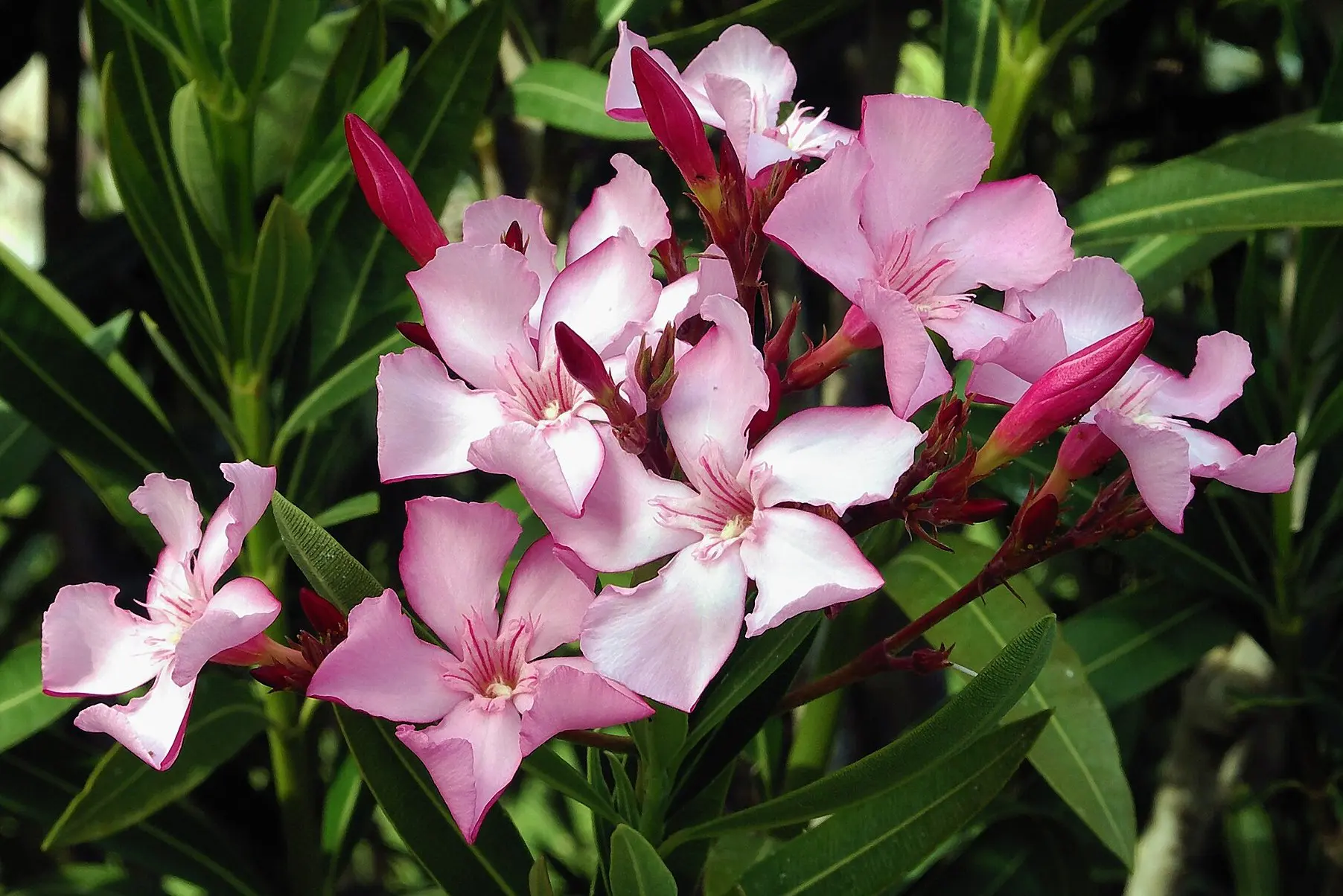
Oleander

Nerium oleander
Pink oleander is one flower you don’t want to smell. An ornamental shrub featuring slender stems with perfumed pink, red, white, or apricot flowers, all parts of this plant are toxic. Nausea, vomiting, abdominal pain, lethargy and dizziness are just some of the early symptoms. With delayed effects ranging from a slow heartbeat to seizures and even coma. Its perfume, for example, can cause respiratory irritation, while skin contact with its sap can cause dermatitis.
Angel’s Trumpets
Brugmansia spp.
If you thought the delicious fragrance and beautiful blooms were intoxicating, just wait till you discover how toxic its leaves and seeds are. As attractive as Angel’s trumpets are, ingesting this plant can cause some severe side effects, including disturbing hallucinations, memory loss, and sometimes even death.
White Cedar
Melia azedarach
Native to Australia and Southeast Asia, white cedar can be found all across the east coast of Australia but has also become naturalised in the Northern Territory and the Kimberley region of Western Australia. Often used as shade trees thanks to their dense canopy, it’s fortunate that the plant prefers growing in the open sun and can withstand extended dry periods and frost.
What’s most remarkable, however, is that the entirety of the White Cedar plant is considered poisonous. Its fruit causes not-so-pleasant symptoms, and when ingested in quantity, sufferers will experience nausea, lethargy, and confusion, with the more dangerous symptoms including coma, seizures, and death. And all it takes is an hour to manifest.
Its leaves are also incredibly poisonous, making them useful as a natural insecticide.
Golden Dewdrop
Duranta erecta
A thorny, evergreen shrub with blue, purple and white flowers, the Golden Dewdrop is the poster child for the unassuming poisonous plant. Though it may be commonly found in Australian gardens, you should be wary of the danger posed to children. Its leaves and unripened berries are confirmed to have killed children, dogs and cats, causing gastro-intestinal irritation, vomiting and diarrhoea if eaten.
Originally native to Mexico, South America and the Caribbean, Golden Dewdrop has been identified as an invasive species in Australia, China, South Africa, Fiji and even Hawaii. Strangely though, birds can eat the attractive orange fruit without dying and are integral to its survival.
Castor Oil Plant
Ricinus communis
We can’t help but giggle at the name Castor oil plant. However, If you were unfortunate enough to consume the Guinness Book of World Records title holder for World’s Most Poisonous Plant, you probably wouldn’t be giggling much longer. Why? Ricin.
A highly potent toxin with the potential as a biological weapon, ricin is found naturally in Castor Oil beans. If inhaled, ricin can cause serious side effects, including fever, chest tightness, cough and severe respiratory problems, including fluid buildup in the lungs. If you thought that was bad, wait until you hear about what happens when you ingest ricin–intestinal bleeding and organ damage. No wonder Walter White was a fan of its toxicity.
But that’s not all. Considered an invasive species in Queensland, the Castor oil plant was native to Africa and India and is now naturalised throughout Australia except Tasmania. It spreads freely in floodplains and waterways when its fruit ripens and explodes, throwing seeds several metres.
Foxglove
Digitalis
Foxglove is notable for its tubular-shaped purple, pink, white, and yellow flowers. Depending on the species, the digitalis plant may contain several deadly toxins, leading to its other nickname, Witch’s Glove. Native to Europe, parts of western Asia, and northwestern Africa, consuming this plant can cause gastrointestinal pain, severe headaches, nausea, vomiting, diarrhoea, and cardiac arrhythmia.
Although death is rare, there are some reports of Digitalis intoxication being fatal. Additionally, even when the plant is dead, it is still toxic, even to animals.
Morning Glory

Ipomoea purpurea
Morning Glory is a noxious weed native to Mexico and Central America that entwines itself around structures. Its trumpet-shaped flowers bloom in either blue, purple or white, which have been known to cause vomiting and diarrhoea. Additionally, its triangular seeds have psychedelic effects similar to LSD.
Spurge (Euphorbia)
Euphorbia spp.
Native to the deserts of southern Africa and Madagascar, Spurge is a diverse genus of flowering plants similar to cacti of North and South America. While the plant itself is relatively harmless, the milky sap it produces evolved to deter herbivores from chowing down on its leaves.
When consumed or in close proximity to your eyes, nose or mouth, the latex can lead to painful inflammation. Something I’m sure we’d all rather avoid. In fact, just ask the serpent king of Ethiopia Arwe, who was killed with the juices of the Euphorbia Spurge.
Poisonous Native Plants in the Australian Bush
Gympie Gympie (Stinging Tree)
Dendrocnide moroides
Another nettle family member, Gympie-Gympie, or the stinging tree, is notorious for its excruciating and long-lasting sting. It grows in rainforests from north Queensland to northern New South Wales, as well as in the Moluccas and Indonesia, and can reach more than 10 metres tall.
Why the Gympie Gympie makes our list is its notoriously painful sting. Even the lightest touch can leave victims suffering for weeks, if not months at a time. Infamously known as the most venomous plant in Australia, contact with Gympie Gympie will cause immediate and severe burning that intensifies in just 20 to 30 minutes.
Like the trichomes in Urtica dioica, the very fine hairs of the Dendrocnide moroides are loaded with the toxin, with only the slightest touch needed to feel their effects. Additionally, its effects can last for weeks and sometimes months because the trichome remains embedded in the skin, regularly releasing the cocktail of toxins into the body.
In fact, it’s so bad, Marina Hurley, a postgraduate student at James Cook University, described its sting as “the worst kind of pain you can imagine – like being burnt with hot acid and electrocuted at the same time,”
Black Bean
Castanospermum australe
The Black Bean is native to Queensland and New South Wales, growing in moist soil along mountainsides and riverbanks and coastal rainforests and beaches along the east coast of Australia. Additionally, it reaches 40 metres and produces glossy dark green pinnate leaves and low spreading branches.
Well known for its small and vibrant flowers of red and yellow, the Black Bean, or ‘Moreton Bay chestnut’, holds a dark secret during the autumn months–large pods filled with toxic seeds that weigh upwards of 30 grams each. Ingesting just one can cause vomiting and diarrhoea.
Milky Mangrove
Excoecaria agallocha
With cultural names like the blinding tree, the blind-your-eye tree and the poison fish tree, you can see why the Milky Mangrove has made it onto our list. Growing across the west of India and in Australia from NSW to the northern coastline of WA, the milky mangrove, as its name suggests. In fact, it grows upwards of 15 metres tall in mangrove swamps and coastal wetlands.
One of its many chemical defence mechanisms is an incredibly poisonous and potent irritant. This milky latex substance can cause skin irritation, rapid blistering, and, if exposed to a person’s eyes, blindness. Even Captain James Cook came into contact with the milky mangrove during his voyages.
Strychnine Tree
strychnos nux-vomica
Native to Australia, India, and South-East Asia, this medium-sized tree with a short, thick trunk grows in open habitats. Its fruit resembles large apples, with seeds in flattened disks covered in tiny hairs.
While it’s not quite the tree itself that’s poisonous, the seeds within its small, orange to green fruit contain the alkaloid strychnine, which can cause tachycardia and hypertension when ingested. Curiously, when consumed at low levels, strychnine can promote appetite and aid digestion. That being said, it’s also commonly featured in rat poison, so best not to tempt it.
Notorious Poisonous Plants Around the World
These plants are less common in Australia but are among the most famous toxic species on the planet.
Aconitum (Wolfsbane)
Aconitum napellus
Wolfsbane, Monkshood and Devils Helmet; names given to beautiful blue flowers poisonous enough to kill you within two to six hours. Although two of its titles are inspired by the helmet-shaped flowers. Wolfsbane clearly indicates just how deadly this plant really is.
Deadly Nightshade
Atropa belladonna
The name pretty much gives it away, but brightly-coloured poisonous berries of the Deadly Nightshade are a nightmare to contend with as just one leaf, or roughly 20 berries, is enough to kill a full-grown adult. For children, it takes even less.
Larkspur
Consolida ajacis
Weakness, drolling, abdominal pain, paralysis, and if injected, death–larkspur is no joke. Although it produces clusters of blue, white or pink flowers, every single part of this plant is toxic to humans and can result in death within a few hours of ingestion. Even touching the plants can cause severe skin irritation.
Dragon Arum
Dracunculus vulgaris
Say hello to the Stink Lily. Also known as the Dragon Lily, Dracunculus vulgaris is endemic to the Balkans, extending as far as Greece. Notable for its rich purple colours. When it blooms, the flowers give off a potent scent. Similar to the stench of rotting meat, which it uses to attract insects for pollination. However, that’s not why it makes our list.
Corpse Flower
Rafflesia Arnoldii
Also known as the giant padma. Rafflesia arnoldii is the world’s largest species of flowering plant in the parasitic genus Rafflesia. Yup, you read that correctly. With no leaves, stems or roots, the Corpse Flower gets its name by growing on the vines of the Tetrastigma, its host plant.
Poison Ivy

Toxicodendron
Poison Ivy is an infamous plant that can cause red, swollen skin, blisters, and severe itching upon contact. More commonly found in North America though widespread across Australia, this is one plant you don’t want to come across during your bushwalk. If you happen to come into contact with poison ivy, baking soda and colloidal oatmeal can alleviate the symptoms.
Nettles
Urtica dioica
Nettles suck. Once native to the European continent, including parts of Asia, nettles can now be found all over the world, from North America to New Zealand. Divided into six subspecies, five of them feature many hollow stinging hairs that give it names like burn nettle and stinging nettle.
Keeping Pets Safe From Poisonous Plants

Our pets are precious, and some popular flowers are not safe for them. Lilies are the big one: every part of a lily, even pollen or vase water, can cause kidney failure in cats. Read why lilies are deadly to cats.
Check the plants in your garden and remove or fence off toxic ones such as oleander, brugmansia and castor oil plant.
Choose pet-safe cut flowers. See our list of 15 pet-safe flowers for cats and dogs.
Keep bouquets and vase water out of reach, and sweep up fallen leaves and petals.
Call your vet straight away if your pet shows vomiting, drooling, lethargy or a change in heart rate after chewing a plant.
Choose Safe Plants and Flowers
Looking for something beautiful that is safer for the home? Browse our plants and our pet-friendly flowers. Always check the care card and keep any plant out of reach of curious pets and children.
While we have made every effort to give accurate information, we can’t take responsibility for harm caused by people or pets eating any plant, flower or stem. If in doubt, call the Poisons Information Centre on 13 11 26.