Move over veils, hats and fascinators, and make way for boho-inspired flower crowns!
Flower crowns are a favourite wedding-day look and are just as popular for engagement parties, hens’ days and festivals. Not that floral adornments have ever been out of fashion: just look at these runway looks spanning the last couple of decades.
Who needs a special occasion for a beautiful flower crown, though? Below we walk you through making one in four simple steps, then cover the best fresh, dried and Australian native flowers to use.
Remember the daisy chains of childhood summers? They were fiddly to make, and you had to walk very carefully to keep them in one piece. A wired crown is much sturdier. All you need are a few essentials and a handful of your favourite flowers.
How to Make a Flower Crown in Four Simple Steps
We’ve made a short video tutorial (below) that goes from sprigs and wire to a finished crown in just over a minute. Or follow our step-by-step guide.
Step 1: Gather Your Materials
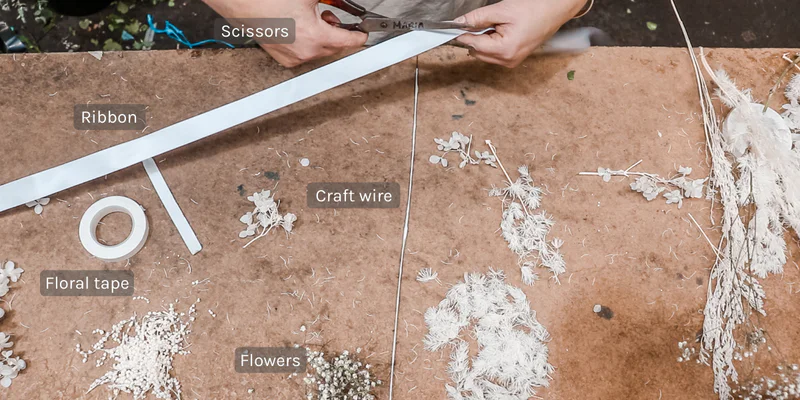
Before you start, gather everything you need and lay it out on a flat surface, away from any draught.
You will need:
Floral or craft wire. Green, silver or white are the most common.
Floral tape. We used white to match our white flowers, but tape comes in lots of colours that change the look of the crown.
Wire cutters or sharp scissors for a clean cut on wire, ribbon and stems.
Ribbon. Ours is white, but you can mix colours, materials and patterns.
Flowers and foliage. We used baby’s breath and hydrangea for a clean white look. Most dried flowers and many fresh ones work well (see below).
Step 2: Don’t Get Your Wires Crossed

Cut your wire to size, then twist the floral tape carefully around it.
Once that’s done, tape a piece of ribbon to one end of the wire.
Tip: how long the wire and ribbon need to be depends on where you want the crown to sit and how much of it you want to cover. In our tutorial, flowers cover well over three-quarters of the crown, almost meeting at the back.
Step 3: Add the Flower Power!

This is the fun part!
Choose your flowers and foliage, cut them to size and tape each sprig or bud carefully to the wire. The smaller the flowers, the longer it takes, but it’s worth it.
Keep all the pieces facing roughly the same way so they won’t be squashed under the wire when you wear the crown. Keep going until you almost reach the end of the wire.
Tip: lay your design out on the table first to get a feel for the look, and swap pieces around if you need to.
Step 4: The Finishing Touches

Once you’ve almost reached the end of the wire, tape another piece of ribbon to it. With a ribbon at each end, you can tie the crown to suit different hairstyles, and it will sit snugly on your head.
Tip: make sure the wire ends are well taped over so there are no sharp edges.
All that’s left to do is put on your dancing shoes and join the party!
Which Flowers Work Well for Flower Crowns?
Fresh flower crowns
Fresh flowers give you scent and vibrant colour, and you can mix fresh and dried blooms for the best of both. If you love lavender, for example, use it fresh: dried lavender tends to drop its buds.
For a fresh crown, combine a few larger focal flowers with fillers and greenery. Ranunculus, spray roses or rosebuds can be the stars, while baby’s breath, wax flower and foliage fill out the shape.
Popular fresh choices are spray roses, orchids, sedum, Queen Anne’s lace, eucalyptus and ivy, but lily of the valley, stock and ferns work too. Choose flowers that are in season, so they’re easy to find and good value, and that won’t wilt quickly in summer heat.
Fresh flower crown method
Fresh flowers are heavier and wilt faster than dried ones, so the method changes a little:
Build the base first. Shape florist wire into a circle that fits your head, twist the ends together, then wrap the whole ring in floral tape so it’s strong and smooth.
Foliage first, then flowers. Tape short pieces of greenery all the way around, securing each in two spots, then add your biggest focal flowers and finish with small fillers.
Keep stems short. Cut each stem to 3–5 cm so the crown stays light and neat.
Mist and chill. Spritz the finished crown with water and keep it in the fridge (not the freezer) until you wear it.


Make a fresh crown on the morning you’ll wear it. It will look its best for about a day.
Dried flower crowns
We wouldn’t be Flowers Across if we didn’t get excited about dried flowers! Dried flowers and leaves won’t wilt, so you can wear your crown again and again. They’re also lighter than fresh flowers and come in lovely natural tones.
Tip: choose flowers and foliage that are sturdy but not brittle. Go for blooms you can easily break into smaller pieces, like the hydrangea in our tutorial. Our dried and preserved flowers are a good place to start.
You might think twice about an all-dried crown for a windy seaside wedding, though, as some dried flowers shed.
Australian native flower crowns
Australian natives make hardy, long-lasting crowns with a relaxed look. Good choices include:
Wax flower, which holds up well and comes in white, pink and purple
Small kangaroo paw stems
Gum leaves (eucalyptus) for foliage and scent
Billy buttons for pops of yellow
Rice flower as a delicate filler
Dried banksia pods for texture
Please don’t pick natives from the wild. Buy them from a florist or grow your own. Browse our Australian native flowers for ideas.
Final tips
Gather your hair to one side with a cluster of flowers instead of a full crown. Use one or two focal flowers such as orchids, peonies or ranunculus, with a few sprigs of ivy.
Nothing says summer like fresh lavender. Pair it with small sprigs of eucalyptus or rosemary to carry the scent with you.
Flowers carry meaning, too. For special celebrations like weddings or engagements, choosing meaningful flowers adds a personal touch.
Planning flowers for the whole wedding? See our DIY wedding flowers guide.
Are you more of a visual learner? Watch our video tutorial:
Are You Feeling Like a Princess Yet?
You should! A flower crown can be the finishing touch to your look, a little statement piece that is uniquely you.
For more ideas, check out these trendsetting floral pieces.
Need flowers for your crown? Browse our dried flowers and native flowers, with same-day delivery when you order before the daily cut-off.