In short: blast aphids off with a hose, squash small clusters, then use an insecticidal soap spray and let ladybirds, hoverflies and lacewings finish the job. Keep chemical sprays as a last resort. In Australia, aphids peak on soft new growth in spring and again in autumn.
Aphids are one of the more common types of pests that you’ll come across as a gardener. If you’re new to gardening or dealing with pests they can be quite a problem to deal with.
That said, with a little bit of know-how you can rid your garden of aphids quickly and without too much trouble.
In this guide, you’ll learn about how to do that and which methods are right for you and your garden.
Let’s get started by taking a quick look at what aphids really are and how they tick.
What are aphids?
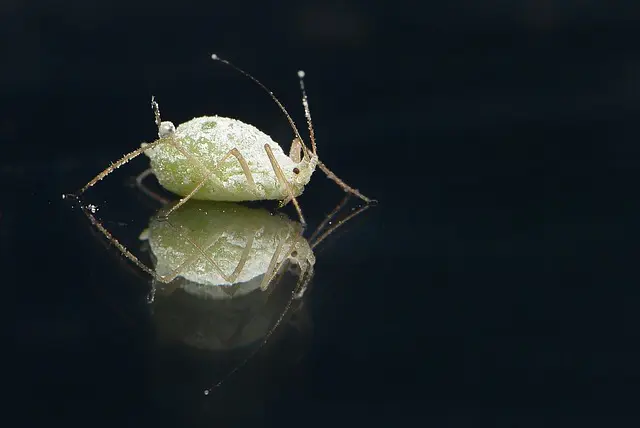
Aphids are small insects approximately 2 millimetres long that can be found in a variety of different colours such as white, black, yellow, green, brown and red.
They survive by feeding on the sap within your plants which they find in leaves, buds, stems and flowers.
One of the reasons they plague so many gardeners is their short reproductive cycle; a single season for your flowers is enough time for aphids to reproduce several times and so their numbers can grow very quickly.
One minute your garden is pest-free, the next it’s overridden with them. When this happens you’ll want to know as soon as possible in order to minimise the damage.
To figure this out it helps to know what aphids look like.
What do aphids look like?

Image by FRANCO PATRIZIA from Pixabay
We’ve already mentioned that they are about 2mm in length and that they can be one of several colours (we’re yet to see a rainbow coloured aphid but you never know!), but there are quite a few bugs out there, so how can you tell one from another?
Aphids can be recognised by their pear-like shape when seen from above.
Other than that, most of their features will be too small for you to make out well without a magnifying glass.
We could tell you that they’ve got six legs, two antennae and a sucker they use to suck out your sap, but it might be a bit hard for you to see them.
So, you’re better off studying a few of the photos here to get a better feel for what they look like.
What do aphids eat?
Aphids eat all sorts of plants; some species are monophagous, meaning that they only eat one species of plant.
While others eat a more varied diet.
That said because humans tend to favour a small subset of plants in their gardens, gardeners typically find aphids on flowering plants like roses and hibiscus, as well as herbs and vegetables like basil, kale and pepper plants.
Regardless of what you plant in your garden, you can find your plants under attack from aphids, so it helps to be on guard.
Are there different types of aphids?
There are about 5,000 different species known to man (and probably more that are unknown).
They have evolved in wide ranges of environments, so it’s natural that there be different species.
They differ by appearance, with insects in the aphid family appearing in a wide array of colours.
You also find that different aphid species vary by other dimensions such as size and diet as well.
Do aphids bite?
Aphids do not bite humans. It’s natural to feel a bit icky around bugs like aphids, but you don’t have anything to worry about when it comes to being bitten or stung by aphids.
They feed on plants not with teeth, but with a tiny sucker that can penetrate plant material but not human skin.
Do aphids fly?
Yes, aphids can fly and are sometimes even known as “green-flies” because of this behaviour. While they often crawl around from plant to plant, the females can fly to a new area which helps them to colonise new plants completely (something you’ll want to avoid)
Ants & aphids (ant mutualism)

One interesting thing to learn is that aphids often have allies in the form of ants.
When aphids feed on your plants, they secrete a substance called honeydew, which ants like to feed on.
So, somehow, ants have learned to farm aphids for their own purposes. They even protect them from ladybirds and other predators. This is known as ant mutualism and is quite incredible when you think about it. If you see ants marching up a plant, check for aphids, and read more in are ants bad for your plants?
How to prevent aphids

When it comes to dealing with aphids, it’s obviously preferable if you can prevent them from ever taking hold in your garden.
How can you do this?
One way is to populate your garden with the kind of insects that like to eat aphids. That way, anytime that aphids begin to take hold, their numbers will be reduced before they can ever make a dent on your plants.
Some examples of such insects:
Ladybirds (ladybugs in the USA)
Lacewings
Parasitic wasps
Hoverflies
Hoverflies are another great ally, and their larvae eat large numbers of aphids. To attract all of these helpers, plant small-flowered companions such as alyssum, dill, coriander, fennel and calendula, and avoid broad-spectrum sprays that kill them too. Our guide to flowers instead of pesticides and organic, sustainable gardening has more ideas.
Some people go as far as ordering these insects by mail. Whether you want to go to these efforts or not depends on how much of a problem aphids have been in the past.
Symptoms of an aphids infestation

Image by Efraimstochter from Pixabay
If prevention has failed and aphids have begun to take hold of your plants, there are a few signs that you can notice before things get too out of hand.
The first (unsurprisingly) is signs of lots of little aphids crawling around on your plants. By now you should have a decent idea of what they look like, so you’ll quickly be able to tell whether or not you have an aphid infestation.
Another symptom is the presence of honeydew on your plants. This is the substance that aphids secrete once they have fed on your plants, so its presence suggests that aphids are also present.
A third symptom is what will happen to your plants if aphids get a hold; they’ll weaken and the leaves will become yellow and brown.
Exactly what happens will vary from plant to plant, but when your plants start to look less than 100% healthy, take a closer look at the plant and see if aphids are the cause.
And if they are? Let’s look at how to get rid of them for good.
How to get rid of aphids (for good)

Image by 👀 Mabel Amber, who will one day from Pixabay
So you’ve done what you could to prevent aphids from taking hold in your garden, but they’re stubborn little creatures and they’ve found a way regardless.
How can you get rid of aphids and keep them away for good?
There are a few different methods, each with their own pros and cons, so let’s take a look at the most common methods.
Start with the gentlest method and only move down the list if the aphids keep coming back.
1. Hose, squash or prune
The first thing you can try is physical force. Grab your hose and use a firm jet of water to wash aphids off your plants, paying attention to the undersides of leaves and the soft tips. For small clusters, simply squash them between your fingers (wear gloves if you prefer), or prune off a badly infested shoot and put it in the bin.
Repeat every few days for a week or two. Sometimes, depending on the severity of your problem, this will be enough on its own.
2. Insecticidal soap spray
Soap sprays work by smothering aphids, and they leave no lasting residue. Use pure soap or a commercial insecticidal (potassium) soap. Many dishwashing liquids contain degreasers and fragrances that can burn leaves, so they are best avoided.
Spray the aphids directly, making sure to reach the underside of the leaves, where aphids often live and feed. Test on a few leaves first, spray in the cool of the day, and repeat every five to seven days while aphids are active.
3. Beneficial insects and companion flowers
Once you’ve knocked numbers down, let nature do the rest. Ladybirds, lacewings, hoverflies and tiny parasitic wasps all feed on aphids. Look out for aphids that have turned bronze and papery: these have been parasitised, so leave them alone. Planting flowers that feed these helpers (see above) keeps them in your garden.
4. Horticultural oil
Horticultural (pest) oil, sold in Australia as winter oil or white oil, smothers aphids and their eggs. Use it on dormant deciduous plants in winter, or as a summer-strength spray on actively growing plants, following the label. Don’t spray in hot weather, as oils can scorch leaves.
5. Diatomaceous earth
Diatomaceous earth is a fine powder that damages the outer layer of soft-bodied insects. It can work on aphids, but it also harms bees and beneficial insects, so don’t use it while your plants are in flower and apply it only where the aphids are.
6. Systemic insecticides (last resort)
Systemic insecticides are chemicals that are absorbed by plants and then circulate throughout the entire plant. When aphids feed, they take in the poison and die. They are effective, but they can affect much more than aphids.
Systemic insecticides (e.g. neonicotinoids) can harm bees and other pollinators. Never use them on flowering plants, and follow the label. For most home gardens, the methods above are enough.
Keep Your Garden Flowering
Aphids are an annoying pest to have in your garden, but with a hose, a soap spray and a few helpful insects, there’s nothing to fear. If your plants are showing other spots, wilts or mould, see our guide to plant diseases.
Want to brighten up your home while the garden recovers? Browse our plants, with same-day delivery when you order before the daily cut-off.