In the floral world, the rose is king. Revered in poetry, film, theatre and music, it’s quite understandable why the rose is the national flower of the United States, the United Kingdom and the Maldives. While roses may be the flower of choice for many of the bouquets, boutonnieres, and centrepieces we deliver, true beauty is found in the variety of flowers that make up some of the National Flowers of the World. Flowers Across has picked out 33 favourite national flowers and the countries and regions they represent.
Australia and the Pacific
1. Golden Wattle — Australia
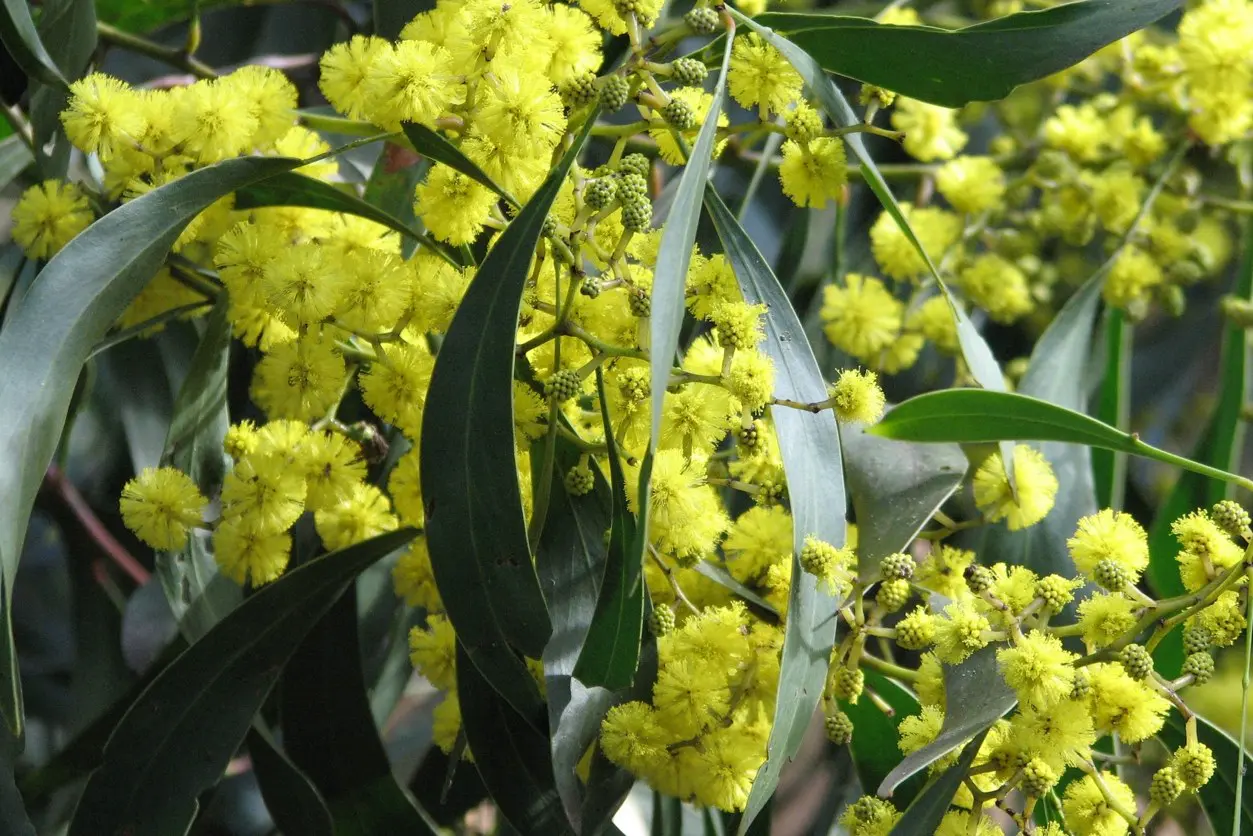
Photo by Melburnian on Wikimedia Commons, CC BY-SA 3.0, cropped

This fragrant shrub with its tiny explosions of yellow flowers is native to south-eastern Australia (South Australia, Victoria, New South Wales and the ACT) and cemented in history as the national flower of Australia. Literally. Some of the region’s first settlers used Acacias to build their wattle and daub homes, subsequently coining the nickname “wattle.” Certain types of Golden Wattle were even used by Aboriginal people to craft weapons and tools. Read more about the Australian wattle tree.
32. Heilala – Tonga
Tonga’s national flower is Heilala. It’s quite popular here, and is used for numerous applications, including making garlands. The colour of its petals range from pink to carmine. Fun fact: the Heilala is among the highest-ranked and most treasured of the Tongan flowers. This is primarily because of its origin. Legend has it that the flower originates from Pulotu, the Tongans’ ancestral homeland.
Europe
2. Iris — France

Image by İsmet Şahin from Pixabay
The Iris, also called fleur-de-lis, has been associated with French royalty since the Middle Ages, when the stylised fleur-de-lis became the emblem of the French kings. The flower takes its name from the Greek word for “rainbow,” and rightfully so; there are around 300 species in a wide range of colours, from snow white to deep purple!
3. Lily of the Valley — Finland

Image by Etienne GONTIER from Pixabay
This delicate plant has tiny bell-shaped flowers that smell extremely sweet, making it a favourite in both perfumes and bridal bouquets. It flourishes in forests and any other cool, shady spot. The flower is both a bane and blessing to gardeners. It’s a blessing because it grows in colonies and spreads quickly. It’s a bane because—you guessed it— it spreads so quickly and can take over a garden in a short amount of time.
4. Tulips — the Netherlands, Hungary and Turkey

Image by RÜŞTÜ BOZKUŞ from Pixabay
Despite popular belief, the perky tulip isn’t Dutch: wild tulips come from Central Asia, and they were cultivated in the Ottoman Empire before making their way to the Netherlands in the late 1500s. In fact, the tulip was once so popular that during the 1600s there was an entire branch of Dutch commerce based around it.
6. Sunflower — Ukraine

Photo by Jdtravers on Wikimedia Commons, CC BY-SA 3.0, cropped

This cheerful flower was originally cultivated in the Americas before becoming the favourite national flower of Ukraine. In fact, 60% of the world’s sunflowers are now grown in Europe and Russia. In traditional folklore the sunflower signifies fertility, solar power and vigour. This is highlighted by the sunflower’s unique tendency to turn its “head” and follow the sun across the sky, drooping down towards the ground when night falls.
11. Edelweiss – Austria
Known by its botanical designation of Leontopodium alpinum, this mountain flower is one of Europe’s best known. Referred to as Queen Flower, this short-lived star-like perennial belongs to the sunflower family. Other than being pictured on Austria’s euro coins, this flower, traditionally used in folk medicine, is considered a remedy in treating both abdominal and respiratory diseases.
18. Bear’s Breech – Greece

Image by QiFlowStudio from Pixabay
Scientifically known as Acanthus mollis, this is the definite favourite of four floral emblems the country embodies. Not only is it favoured for its ornamental aesthetics, but also its use in the architecture of both the Greek and Roman societies throughout the centuries. The curled foliage is most frequently seen carved into stonework atop of columns or in the artwork.
19. Camomile – Russia

Image by Manfred Richter from Pixabay
With a fruity, floral, aromatic fragrance, Camomile is in the daisy family. A native to Asia’s western areas, this flower is known to grow freely and prolifically. With its various medicinal uses, this flower is considered an essential remedy in central Europe. Blue chamomile oil is known to be very soothing, with the addition of dried flowers that can produce a relaxing infusion.
20. Thistle – Scotland and Lorraine

Thistle is a common name used for a flowering group of plants that present with margins that contain sharp prickles. Their prickles will also be all over the plant—on both the stems and the leaves. The prickles serve as a protective adaptation that makes the plant undesirable by herbivores.
21. Rose – Slovakia

Image by Myriams-Fotos from Pixabay
A deciduous shrub, the rose is recognised the world over as a symbol of not only love and beauty but also of war and politics. This flower is one of the most well-received gift items known, as few do not love the rose. Fossils show that roses have existed for around 35 million years, when the world was very different from today. With the rose’s perfume being its main attraction, the flower is associated with emotions across the globe. The rose grows best in well-drained, moist soil, with the benefit of either full or partly shaded sun.
22. Red Carnation – Spain

Commonly known as Clavel in Spanish, red carnations are traditional flowers used to express gratitude and feelings since ancient Spain. The peasants used to adorn their beautiful white houses with red carnations. The flower has been part of Spain’s numerous traditions and culture, symbolising fascination and love. The red, bright carnations bloom in the month of June every year for six to eight weeks. In Spanish folk tradition, red carnations were also thought to help relieve insomnia, depression, weakness, and stress.
23. Lavender – Portugal

Image by 🌼Christel🌼 from Pixabay
Lavender is part of an extended mint family, and in Portugal, the plant is a highly popular cooking ingredient. The flower contains potent oils that are mainly used in perfumes, essential oils, cosmetics, and other health and beauty products. Lavender has soporific effects and therefore, people in Portugal keep it under their pillow. People also cherish the bright purple colours of the flower and use it in many decorative items.
25. Linnea – Sweden

Photo by Walter Siegmund on Wikimedia Commons, CC BY-SA 3.0, cropped

Linnea is a very delicate wildflower that grows in the deep shadows of Northern spruce forests in Sweden. The flower is named after Linnaeus, who is also celebrated as the Swedish father of Taxonomy. The flower is renowned for its unique appearance. To start with, the stems are extremely thin and each stem boasts at least two flowers. Now, what’s interesting is that Linnea can be found in different colour variants within the same region. However, the most popular one is the pink Linnea that is tremendously fragrant and has a bell-like appearance.
30. Tudor Rose – England

Image source: Pixabay
England’s floral badge is the Tudor rose. It’s also aptly named as the Union rose to represent the coming together of two English houses: Lancaster and York. This floral emblem consists of bright red colour with five white inner petals and five red outer petals. While the flower doesn’t really exist in the plant world, its emblem is very common in England. It’s engraved on the Hampton Court Palace building and appeared on British 20p coins!
Asia
5. Jasmine — Pakistan and Syria

Photo by Dinesh Valke from Thane, India on Wikimedia Commons, CC BY-SA 2.0, cropped

The jasmine has been cultivated for thousands of years for its tiny, star-shaped flowers and intoxicating fragrance. Its simplicity and pure white colour symbolises purity and peace. Used in cosmetics, perfumes, cooking, aromatherapy, garlands, as hair decorations and in various cultural ceremonies, it’s easy to see why this is the favourite flower of multiple countries. Learn more in our complete guide to jasmine.
7. Orchid — Honduras (and Hong Kong’s bauhinia, the ‘Hong Kong orchid tree’)

Image by Iva Castro from Pixabay
Orchids are extremely popular and widely cultivated. There are more than 25,000 different species, and new ones are still being discovered. Orchids resemble the human face in that they have a bilateral symmetry, perhaps explaining why they are so popular. These exquisitely unique flowers are prized in decorations and bouquets and are featured in a traditional beverage called “Sahlep” in Turkey. The drink later reached England, where “saloop” was sold from London street stalls. Hong Kong’s floral emblem, by the way, isn’t a true orchid: it’s the bauhinia (Bauhinia × blakeana), nicknamed the Hong Kong orchid tree, which appears on the Hong Kong flag.
8. Chrysanthemum and Cherry Blossom — Japan

Image by milky_way_shore from Pixabay
Image by congerdesign from Pixabay
Japan is often said to have two national flowers. Cherry blossoms bloom for just a short time, and they signify the fragile beauty of life. While the cherry blossom is Japan’s best-loved flower, the chrysanthemum has been a symbol of the Japanese royal family for centuries and is celebrated each year during the “Festival of Happiness.” Read our chrysanthemums guide.
10. Lotus — India

Photo by Peripitus on Wikimedia Commons, CC BY-SA 4.0, cropped

Basically an aquatic flower, lotus holds a great significance in Indian history. There is hardly any painting or sculpture that doesn’t emphasise the beauty of the lotus flower. Growing in lakes and ponds, this sacred flower occupies a significant position in the mythology of ancient India. In the Hindu holy book – Bhagavad Gita, the lotus flower has been used as a metaphor for detachment. This is because lotus grows in muddy waters and remains untouched. The flower also symbolises beauty and knowledge as Saraswati – the Goddess of Learning is portrayed as seated on it.
24. Ratchaphruek – Thailand

Image source: Pixabay
It was not until 2001 when Ratchaphruek was named the national flower of Thailand. It is a big tree that blooms bright yellow flowers. Ratchaphrueks grow in clusters and seem like they are about to tumble like raindrops. In Thailand, Ratchaphruek means a royal tree. This tree is also dedicated to the late King of Thailand, King Bhumibol Adulyadej. The King was born on a Monday, and in Thailand, Monday’s colour is yellow. Therefore, Ratchaphruek fits perfectly with all these scenarios.
33. Rose of Sharon – South Korea

Photo by Tiffany825 on Wikimedia Commons, CC BY 3.0, cropped

South Korea’s national flower is called the rose of Sharon. Its scientific name is Hibiscus syriacus, which places it in the hibiscus genus. There are many varieties of this flower, all of which come in very flashy colours. ‘Blue Satin’, one of its cultivars, is a bluish flower with a red centre.
Africa
9. Pepper — Liberia

Image by Angeles Balaguer from Pixabay
It may seem odd to see the pepper tree on our list; however, pepper berry sprigs and sprays can be quite effective when used in seasonal flower arrangements. When you’re looking for a unique bit of visual pop to add to an arrangement, the pepper’s got it.
12. Protea – South Africa

Photo by Pierre André on Wikimedia Commons, CC BY-SA 4.0, cropped

The artichoke-like appearance of the protea flower is a beauty in itself. It is available in several different colour schemes, but the pink-coloured proteas are the most beautiful. They belong to one of the oldest families of flowering plants, with a history going back tens of millions of years. In 1735, botanist Carl Linnaeus, also known as the father of taxonomy named and classified protea. The name protea signifies Proteus, who is the son of Poseidon. Proteus translates to a shape-shifter, and since the flower is found in a variety of different shapes and colours, this name best suits it.
17. Calla Lily – Ethiopia and Saint Helena

Image by thuyhugens from Pixabay
Also known as the Arum Lily, this flower is native to southern Africa, including Eswatini. Most commonly white in colour, they can reach a height of up to 60–90 cm. The leaves, which are broad and dark green, typically grow up to 45 cm long. The centre of the flower features a yellow spadix of colour and produces a delightfully sweet fragrance. The Calla Lily is Ethiopia’s official flower because it grows in such abundance and the people of the country consider them a sign of peace.
27. Flame Lily – Zimbabwe

Image by DL ART PHOTOGRAPHY from Pixabay
Globally, flame lily is often seen as a symbol of purity. But in Zimbabwe, it’s deeply woven in the nation’s history. It’s actually been their national flower since 1980 when the country gained independence. The flame lily takes on an array of colours ranging from a dark shade of pink to orange, yellow, and red. But despite its vibrancy, this one is a killer. It contains colchicine, a toxic alkaloid, which can be fatal if eaten.
The Americas
13. Dwarf Poinciana – Barbados

Photo by Charles J. Sharp on Wikimedia Commons, CC BY-SA 4.0, cropped

Also referred to as the Pride of Barbados, although native to the Tropics of the Americas, this flower can be found in both India and the Philippines. A heat-loving plant, the Pride of Barbados, produces flowers throughout most of the year, with branches that are prickly and large leaflets for its leaves. Featuring five sepals its flowers measure about 4 cm across.
14. Black Orchid – Belize

Photo by D. Joshua Zampini on Wikimedia Commons, CC BY 3.0, cropped

With over 100 different varieties of orchids that flourish in Belize, the national flower of Belize is that of the Black Orchid. The orchid is also known by the name of cockle shell orchid or clamshell orchid. Flowering almost all year round, this variety of orchid grows primarily on trees located in damp areas. With bulblike, greenish-yellow clustered stems, which can be up to 15 cm long, the leaves are usually two to three in number.
15. Pacific Dogwood – British Columbia

The province’s official flower isn’t a flower—but rather a tree. The Pacific Dogwood was adopted as the province’s official flower in 1956. With bright, attractive blooms, the flower can grow in both a wild and a cultivated form. In Canada, the Pacific dogwood grows wild only in the south-west corner of British Columbia, including Vancouver Island; it is also native further south along the Pacific coast of the United States.
16. Christmas Orchid – Colombia

Photo by QuazDelaCruz on Wikimedia Commons, (CC0), cropped

This orchid is an epiphytic orchid, featuring succulent leaves and is endemic to Colombia. Much like the Colombian flag, the flower presents with a lip that is blue, red, and yellow. Also known as Cattleya trianae, this orchid was named after a Colombian botanist of the 19th Century Jose Jeronimo Triana. Growing at levels of 1,500–2,000 metres above sea level, the Christmas Orchid, due to destruction of its habitat, is classified as an endangered species.
26. Maple Leaf – Canada

Image by HeungSoon from Pixabay
The maple leaf is not just Canada’s national emblem but also part of its flag. So, you can only imagine the significance it boasts to the Canadians. In 1996, the maple tree was officially proclaimed Canada’s national arboreal emblem. The patriotic song ‘The Maple Leaf Forever’ was composed in 1867, and Canadian soldiers wore maple leaf badges during WWI.
28. Yellow Trumpet – Virgin Islands

Photo by The Cosmonaut on Wikimedia Commons, CC BY-SA 2.5 ca, cropped

With its bright yellow and show-stopping trumpet-shaped structure, the Yellow Trumpet flower is hard to miss. Native to the tropical Americas, this is the Virgin Islands’ territorial flower: the yellow elder or ginger thomas (Tecoma stans), a shrub with clusters of bright yellow trumpets. The flower grows in clusters, and it blossoms year-round. These two traits make it one of the best for decorative purposes.
29. Ceibo Erythrina – Uruguay

Photo by Krzysztof Ziarnek, Kenraiz on Wikimedia Commons, CC BY-SA 4.0, cropped

If you’ve been looking for some red flowers to add to your garden, the Ceibo Erythrina is your best bet. With its flaming red colour, this flower is sure to draw attention to itself. The bloom is known by other names, such as Cockspur or Cockscomb. It is so named because its scarlet colour is similar to that of a cock’s comb on a rooster’s head.
31. Chaconia – Trinidad and Tobago

Photo by Albert Sydney on Wikimedia Commons, CC BY-SA 3.0, cropped

The floral badge of Trinidad and Tobago is the Chaconia flower. Also known as ‘Wild Poinsettia’, this flower can be identified through its fiery hue and long sprays of the vermilion pigment. The flower blossoms at around the same time the country celebrates its independence, that is, August.
Bring the World’s Flowers Home
You don’t need a passport to enjoy flowers from around the world. Send a bunch of roses, tulips, orchids or sunflowers from Flowers Across, with same-day delivery when you order before the daily cut-off.
Love Australian emblems? Read about Australia’s state flowers.