You can cut back on pesticides by planting flowers and herbs that attract the insects and animals that eat garden pests. Ladybirds, hoverflies, lacewings and parasitoid wasps control aphids, caterpillars and whitefly, and plants like marigold, dill, coriander and alyssum bring them into your garden.
This guide covers the most common Australian garden pests, their natural predators, and the flowers that attract those predators.
Pesticides are substances used to prevent, destroy, repel or control pests. Many can also harm bees and other pollinators, so it’s worth avoiding them where you can.
Be aware when buying plants that some may have been treated with systemic pesticides, which can stay in the plant for a long time. Plants grown from neonicotinoid-treated seed (mostly commercial crop seed) can carry the chemical into their nectar and pollen, where it may harm pollinators. Regulators in Australia and Europe have reviewed the use of these pesticides.
If you want to be sure your plants are free of harmful pesticides, grow them from seed or buy from an organic supplier.
Nature has been doing this forever, individual flowers, plants and conditions help attract predators which in turn increases the biodiversity of your garden by preying on our most common garden pests and restoring the natural balance.
Predators are great at preventing a single species from becoming dominant which includes other predators….there’s always a bigger bug.
By improving the soil (natural organic methods are best), your plants will become stronger, healthier and more resistant to pests and disease. A good practice is to Add companion plants that deter unwanted critters and benefit nearby plants. Also growing flowering plants to attract bees and pollinators are all excellent alternatives to pesticides.
So with all of these methods combined, you can create a more vibrant ecosystem that will not only benefit you but also nature.
Keep reading to find out which are the best flowers and plants, the best predators to attract, and the most common pests that reside in our gardens. The focus of this article is for natural Australian flora and fauna, due to Australia often having extreme differences in climates some species and flowering seasons may vary depending on your location.
Common Garden Pests and Their Natural Predators
Aphids
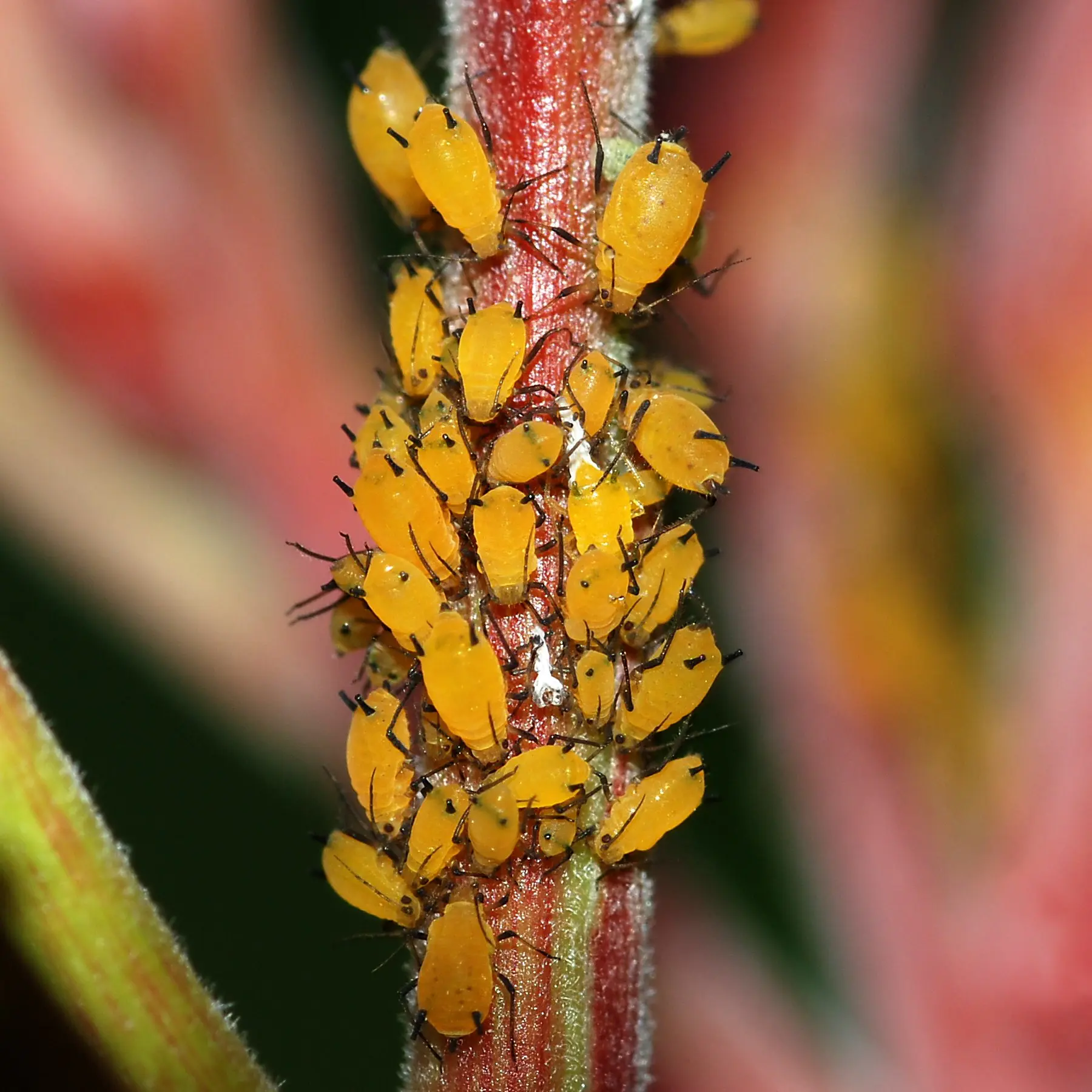
Photo by Alvesgaspar on Wikimedia Commons, CC BY-SA 4.0

Natural predators include:
Ladybirds
Predatory/parasitoid wasps
Predatory/parasitoid flies
Praying Mantis
Lacewings
Spiders
True Bugs
Cabbage white butterfly (caterpillar)

Photo by Holger Krisp on Wikimedia Commons, CC BY 3.0

A natural alternative to pesticides:
Small birds
Ladybirds
Predatory/Parasitoid wasps
Predatory/Parasitoid flies
Praying Mantis
Lacewings
Spiders
True Bugs
Remove them by hand
Whitefly

Photo by Anatoly Mikhaltsov on Wikimedia Commons, CC BY-SA 4.0

A natural alternative to pesticides:
Predatory/Parasitoid wasps
Predatory/Parasitoid flies
Praying Mantis
Lacewings
Spiders
True Bugs
Vacuuming them up early in the morning when it’s cold and they are slow (portable vacuum)
Snails and Slugs

Photo by James Niland on Flickr, CC BY 2.0
A natural alternative to pesticides:
Birds
Lizards/Skinks
Centipedes
Frogs
Predatory beetles
Remove them by hand or set traps are the most effective, predators alone will struggle to keep these guys in check.
Scale/Mealybugs

Photo by Tero Keski-Valkama on Wikimedia Commons, CC BY-SA 4.0

A natural alternative to pesticides:
Predatory/Parasitoid wasps
Predatory/Parasitoid flies
Praying Mantis
Lacewings
Spiders
True Bugs
Redback and Brown Widow Spiders

Photo by Donald Hobern on Wikimedia Commons, CC BY 2.0

“Don’t move, don’t make eye contact…”
A natural alternative to pesticides:
Daddy long leg spider
Black House Spiders
Whitetail Spiders
Predatory wasps
Remove them and egg sacks or use a cordless vacuum (wear gloves, do not get bitten!).
Tips to attract the predators:
Do not use pesticides (unfortunately, if your neighbour uses pesticides this may affect your garden)
Add a permanent source of water near your garden for predators and also other beneficial insects and creatures like bees and lizards.
Keep your garden a little messy as a good layer of leave litter, organic mulch or ground cover provides predators with a good habitat.
You must have a good supply pests around to attract the predators, lucky for us this is normally not an issue! studies have shown plants under attack by pests release a chemical cry for help that attracts the predatory insects.
Plan your garden, canopy, middle layer, ground cover, choose shade-tolerant plants under the taller plants.
Plant as many herbs as possible throughout your gardens, let them bolt and go to flower as almost all herbs attract beneficial insects and their prey.
Plant a border of mixed native and introduced flowering plants, select plants that flower at different times throughout the year, so you always have attractive flowers.
Provide a range of shelters for the predators, like hollow logs, small dense shrubs, crevices under rocks and nesting boxes
Flowers That Attract Beneficial Predators
Marigold (Tagetes tenuifolia)

Photo by André Karwath aka Aka on Wikimedia Commons, CC BY-SA 2.5

Marigold is an easy to grow, annual plant, it Flowers from mid-summer to early winter, prefers a sunny position and has beautiful flowers. It is said to repel some nematodes and a variety of pests. Snails and slugs enjoy a good feed of marigold so this will distract them from your other plants and the flowers are edible…Yum!.
Attracts natural predators such as:
ladybirds
Hoverflies
Damsel and Assassin bugs
Parasitoid wasps
Mantis
Parsley (Petroselinum crispum)

Photo by Forest & Kim Starr on Wikimedia Commons, CC BY 3.0

Parsley is an easy to grow biennial herb that likes full sun and part shade, flowers from late summer to autumn and is said to repel some pest beetles.
Attracts natural predators such as:
Ladybirds
Hoverflies
Tachinid Flies
Parasitoid wasps
Coriander (Coriandrum sativum)

Photo by Didier Descouens on Wikimedia Commons, CC BY-SA 4.0

Coriander is an annual herb that likes full sun and part shade, generally flowers spring to autumn and it’s said to repel some pest beetles, aphids and spider mites
Attracts natural predators such as:
Ladybirds
Hoverflies
Lacewings
Parasitoid wasps
Mantis
Dill (Anethum graveolens)

Photo by Bff on Wikimedia Commons, CC BY-SA 3.0

Dill is an annual herb that likes full sun and part shade; Generally flowers between summer and autumn. Said to repel aphids, squash bugs and spider mites
Attracts natural predators like:
Ladybirds,
Hoverflies,
Lacewings
Parasitoid wasps
Mantis
Fennel (Foeniculum vulgare)

Photo by Forest and Kim Starr on Flickr, CC BY 2.0
Fennel is a perennial herb that likes full sun and fertile soil, generally flowers from summer to autumn and said to repel aphids, snails and slugs. Beware that Fennel is classed as a declared weed in parts of Australia, including Victoria, so please check with your local council before planting.
Attracts natural predators like:
Ladybirds
Hoverflies
Lacewings
Parasitoid wasps
Mantis
Damsel and Assassin bugs
Spearmint (Mentha spicata)

Photo by Charles J. Sharp on Wikimedia Commons, CC BY-SA 4.0

Spearmint is an easy to grow perennial herb that will take over your whole garden so plant it in containers. Flowering season is late spring to early winter and is said to repel fleas, moths, ants, beetles, rodents, aphids and squash bugs
Attracts natural predators like:
Hoverflies
Parasitoid wasps
Damsel and Assassin bugs
Cosmos (Cosmos bipinnatus)

Photo by Forest and Kim Starr on Flickr, CC BY 2.0
Cosmos is an easy to grow medium sized plant; it produces beautifully scented flowers to attract all sorts of beneficial creatures. Flowers from spring to winter and said to repel the Corn Earworm
Attracts natural predators such as:
Hoverflies
Damsel and Assassin bugs
Parasitoid wasps
Mantis
Alyssum(Aurinia saxatilis and Lobularia maritima)

Photo by Forest and Kim Starr on Flickr, CC BY 2.0
Alyssum has potential to flower all year round, enjoys full sun to part shade and is excellent at attracting Hoverflies that eat aphids!!
Available in a multitude of colours and is highly fragrant.
Attracts natural predators such as:
Ladybirds
Hoverflies
Parasitoid wasps

Photo by Dominicus Johannes Bergsma on Wikimedia Commons, CC BY-SA 4.0

Michaelmas daisies(Aster spp.)
Asters are mostly daisy-like perennials, but you can get annuals and biennials. Flowering season is generally Summer to Autumn, and they are excellent pollinator magnets.
Attracts natural predators such as:
Ladybirds
Tachinid flies
Damsel and Assassin bugs
Some lizards will eat the flowers
Lemon Balm(Melissa officinalis)

Photo by Forest and Kim Starr on Flickr, CC BY 2.0
Lemon Balm is a perennial herb in the mint family with the leaves having a lemon scent. Flowering season is from Summer to Autumn and said to repel mosquitoes.
Attracts natural predators such as:
Hoverflies
Damsel and Assassin bugs
Parasitoid wasps
Thyme (Thymus spp.)

Photo by Krzysztof Ziarnek, Kenraiz on Wikimedia Commons, CC BY-SA 4.0

Thyme is an evergreen herb, flowering season is generally Spring to Summer and prefers full sun. Said to repel Corn Earworm, tomato hornworm and whiteflies. The Thymus serpyllum is an excellent alternative to lawn!
Attracts natural predators such as:
Hoverflies
Tachinid flies
Parasitoid wasps
Goldenrod(Solidago canadensis .)

Photo by Forest and Kim Starr on Flickr, CC BY 2.0
Goldenrods are mostly perennial plants which generally flowers in Summer to Autumn. The dried leaves are used to make a Delicious tea and said to have calming properties. This species is restricted in some parts of Australia (check the WA organism list), so check with your local council before planting.
Attracts natural predators like:
Ladybirds
Hoverflies
Tachinid flies
Parasitoid wasps
Lacewings
Damsel and Assassin bugs
Mantis
Beneficial Predators to Welcome Into Your Garden
Ladybirds (Coccinellidae)

Photo by Luc Viatour on Wikimedia Commons, CC BY-SA 3.0

There are over 500 species of ladybird in Australia, and most of them will eat our common pests and substitute their diets with pollen and plant material. The Ladybird larvae will feed on more aphids than the adults so it’s important that you leave those mould and mildew covered leaves in the garden after certain plants like Zucchini have been harvested because ladybirds like to lay their eggs under them and other leaves. A few ladybirds also feed on mildew and fungus that is another common pest in the garden.
Ladybird Larvae. Photo by Natalka Ukraine on Wikimedia Commons, CC BY 4.0

A few favourite flowers to attract the beneficial ladybirds are:
Coriander (Coriandrum sativum)
Dill (Anethum graveolens)
Common yarrow (Achillea millefolium)
Fennel (Foeniculum vulgare) ** classed as a weed in some states check your local council plant restrictions
Prairie sunflower (Helianthus maximilianii)
Marigold – lemon gem (Tagetes tenuifolia)
Zuccini- (Cucurbita spp.)
Michaelmas daisy (Aster spp.)
Parsley (Petroselinum crispum)
Alyssum (Alyssum spp.)
Goldenrod (Solidago canadensis)**restrictions in NSW
Hoverflies (Syrphidae)

Photo by James Niland on Flickr, CC BY 2.0
There are many species of Hoverflies also known as flower flies in Australia.Hoverflies are a fantastic alternative to pesticides. Size ranges from 8 to 20mm, and they feed on nectar, honeydew produced by aphids some species also dine on most soft-bodied pests. Hoverflies tend to lay their eggs in on near aphid colonies and when the larvae hatch they gorge themselves on all the nearby tasty aphids.
A few favourite flowers to attract the Hoverflies are:
Coriander (Coriandrum sativum)
Dill (Anethum graveolens)
Common yarrow (Achillea millefolium)
Fennel (Foeniculum vulgare) ** classed as a weed in some states check your local council plant restrictions
Marigold – lemon gem (Tagetes tenuifolia)
Spearmint (Mentha spicata)
Parsley (Petroselinum crispum)
English lavender (Lavandula angustifolia)
Caraway (Carum carvi)
Cosmos (Cosmos bipinnatus)
Lemon balm (Melissa officinalis)
Thyme (Thymus spp.)
Goldenrod (Solidago canadensis)**restrictions in NSW
Lacy phacelia (Phacelia tanacetifolia)
Alyssum (Alyssum spp.)
Tachinid flies (Tachinidae)

Photo by James Niland on Flickr, CC BY 2.0
Tachinid Flies are Protelean parasitoids; they begin life as a parasite. These guys target most commonly parasitise the immature life stages (eggs, larvae or caterpillars, nymphs, and/or pupae) of beetles, butterflies, and moths. As well as earwigs, grasshoppers, sawflies, and True-Bugs. This is achieved by either laying eggs on potential food for the intended host, near, on or in the host and some even lay live young. Tachinid fly adults commonly feed on nectar and pollen and are diverse in appearance from plain Jane to brightly coloured.
A few favourite flowers to attract the tachinid flies are:
Thyme (Thymus spp.)
Lemon balm (Melissa officinalis)
Parsley (Petroselinum crispum)
Lacy phacelia (Phacelia tanacetifolia)
Passionfruit (Passiflora edulis)
Michaelmas daisy (Aster spp.)
Goldenrod (Solidago canadensis)**restrictions in NSW
parasitoid wasp (superfamily: Ichneumonoidea, Megalyridae, Evanioidea, Chalcidoidea and Chrysididae)

Photo by James Niland on Flickr, CC BY 2.0
We have over 12,000 species of wasp in Australia with most of them being a protelean parasitoid wasp species, spending most of their lifespan as a parasite that usually ends up killing the host. There are too many wasps to be specific about target prey as many of them are selective, but they are excellent to have in your garden. If you do not have the food that they prefer, then they will not hang about. We have a few native flower wasps that have no wings and resemble ants, and few species are being used to control fruit fly. Most of the wasps are incapable of stinging humans; the adults feed on nectar, pollen and honeydew from aphids.
A few favourite flowers to attract the parasitoid wasps that we want are:
Coriander (Coriandrum sativum)
Dill (Anethum graveolens)
Common yarrow (Achillea millefolium)
Fennel (Foeniculum vulgare) ** classed as a weed in some states check your local council plant restrictions
Marigold – lemon gem (Tagetes tenuifolia)
Spearmint (Mentha spicata)
Parsley (Petroselinum crispum)
Caraway (Carum carvi)
Lemon balm (Melissa officinalis)
Thyme (Thymus spp.)
Goldenrod (Solidago canadensis)**restrictions in NSW
Sea lavender (Limonium australe)
Cosmos (Cosmos bipinnatus)
Alyssum (Alyssum spp.)
Lacewings (Order Neuroptera)

Lacewing larvae. Photo by James Niland on Flickr, CC BY 2.0
We have over 600 species of lacewings in Australia, range in size from 5mm to 150mm and colours from bright green to brown and black. The main ones we want to attract are the green lacewings (Family Chrysopidae) and brown lacewings (Family Hemerobiidae) which love to feed on pests such as aphids, scale insects, moth eggs and caterpillars. Some of them also feed on nectar and plant material. Most of the Lacewings larvae (particularly the Antlion Lacewings) consume a lot of garden pests too.
Photo by James Niland on Flickr, CC BY 2.0
A few favourite flowers to attract the lacewings that we want are:
Coriander (Coriandrum sativum)
Dill (Anethum graveolens)
Fennel (Foeniculum vulgare) ** classed as a weed in some states check your local council plant restrictions
Alyssum (Alyssum spp.)
Prairie sunflower (Helianthus maximilianii)
Giant Angelica (Angelica gigas)
Cosmos (Cosmos bipinnatus)
Wild carrot (Daucus carota)
Goldenrod (Solidago canadensis)**restrictions in NSW
Damsel Bug (family Nabidae)

Photo by Judy Gallagher on Wikimedia Commons, CC BY 2.0

Damsel bugs or Nabids are predatory “true bugs”, they prey on aphids, caterpillars, mites, larvae and eggs, and occasionally feed on other predators. Damsel bugs ambush and actively seek out their prey. They generally range from 5 to 12 mm, and some do supplement feeding on plants but its minimal. Over winter damsel bugs like a groundcover and this will help them to return in spring. Another True-Bug that we want in our gardens is the Big-eyed Bugs (Geocoris spp.) which are attracted and target pests in similar ways to the Assassin and Damsel bugs.
A few favourite flowers to attract the Damsel Bugs:
Caraway (Carum carvi)
Fennel (Foeniculum vulgare) ** classed as a weed in some states check your local council plant restrictions
Spearmint (Mentha spicata)
Cosmos (Cosmos bipinnatus)
Goldenrod (Solidago canadensis)
Alfalfa (Medicago sativa)
Marigold – lemon gem (Tagetes tenuifolia)
Michaelmas daisy (Aster spp.)
Wild carrot (Daucus carota)
Goldenrod (Solidago canadensis)**restrictions in NSW
Assassin Bugs (Family Reduviidae)

Photo by James Niland on Flickr, CC BY 2.0
Assassin bugs are generally 12 to 18mm long and like the Damsel bugs these guys are predatory “true bugs” that often target aphids, caterpillars, mites, larvae and eggs, and occasionally feed on other predators.
Also like Damsel bugs, Assassins are masters at ambushing prey, they grab the prey with their front legs and inject it with a salivary secretion that immobilises the prey and dissolves its insides….feeling sick? Once it sucks out the insides, the empty shell of the prey is left. You should be gentle when handling the big ones as they can bite if threatened and the bite can be painful.
A few favourite flowers to attract the Assassin Bugs (same as Damsel bugs):
Caraway (Carum carvi)
Fennel (Foeniculum vulgare) ** classed as a weed in some states check your local council plant restrictions
Spearmint (Mentha spicata)
Cosmos (Cosmos bipinnatus)
Goldenrod (Solidago canadensis)
Alfalfa (Medicago sativa)
Marigold – lemon gem (Tagetes tenuifolia)
Michaelmas daisy (Aster spp.)
Wild carrot (Daucus carota)
Goldenrod (Solidago canadensis)**restrictions in NSW
Mantids (Family Amorphoscelidae, Mantidae and Hymenopodidae)

Photo by Charles J. Sharp on Wikimedia Commons, CC BY-SA 4.0

These guys can be a gardener’s best friend for ridding pests and general entertainment. Most of us know them as the praying mantis and as a child, you were probably fascinated by them, look at their big bug eyes…. The Preying Mantis are experts at camouflage and often very hard to spot. A common misconception is that when the praying mantis mates the female removes the head of the male…. this has been observed to occur within a few species and under certain conditions however they are known to cannibalise. Mantids dine on a variety of common pests including crickets, grasshoppers, spiders and aphids just to name a few. They are fast enough to catch flies, mosquito’s and moths and often hunt at night.
A few favourite flowers to attract the Mantids:
Rose (Rosa spp.)
Raspberry (Rubus spp.)
Cosmos (Cosmos bipinnatus)
Dill (Anethum graveolens)
Marigold – lemon gem (Tagetes tenuifolia)
Hosta (Hosta spp.) **snails love these
Goldenrod (Solidago canadensis)**restrictions in NSW
Lizards and Skinks

Photo by Poyt448 Peter Woodard on Wikimedia Commons, Public domain

Photo by Pete Woodall on Wikimedia Commons, CC BY 4.0

The Lizards and Skinks that we generally have in our back yards are omnivores. They have a wide variety diet that includes snails and slugs, crickets and grasshoppers to name a few and they also eat plants and fruits. Lizard and Skink populations have taken a hit due to some factors with one of them being pesticides! For example, if we use snail bait and the lizard feeds on the poisoned snail they too will be affected by the poison. Humans destroying their habitats is another, and our pets also like to catch and kill them. These guys are a fantastic addition to your garden often seen in the corner of your eye but gone when you focus in on them. (Lizards may sample some of your fruit and veggie’s but they work for it)
Lizards and Skinks need full sunny positions so place a few large rocks in sunny spots for them to bask on, lots of places to hide and make sure there is a permanent water source nearby. Good cover of garden mulch is recommended but avoid pine as it may be toxic to reptiles.
A few favourite plants and flowers to attract lizards and skinks:
Dwarf Baeckia (Baeckia sp.)
Bottlebrush (Callistemon sp.)
Wallaby Grass (Austrodanthonia spp.)
Purple Coral Pea (Hardenbergia violacea)
Kangaroo Grass (Themeda triandra)
Mat Rush (Lomandra longifolia
Native Violet (Viola hederacea)
Hibiscus spp.
Michaelmas daisies(Aster spp.)
Fruit and vegetables
Daddy long legs spiders (Pholcus phalangioides)

Photo by Didier Descouens on Wikimedia Commons, CC BY-SA 4.0

We all know these guys, the daddy long legs spider is known to prey on redback and brown widow spiders and also preys on other garden pests. The common black house spider is also known to deter redback’s and generally if you have black house spiders around redbacks tend to keep their distance.
A rumour circulated stating daddy longs spiders had the most toxic venom in the world, but its fangs were too small to bite humans…. Untrue, Mythbusters (TV show) recently proved this false. They can bite humans and as long as you’re not allergic to their venom then you will hardly notice.
Our eight-legged friends also eat a multitude of pests in and around our homes and gardens including aphids, flies, mosquitoes and crickets. Spiders play a significant role in our ecosystems and unless threatened they are generally harmless to us.
They are not attracted to certain plants, but you will most likely have them already.
Centipedes (order Scolopendramorpha)

Photo by Didier Descouens on Wikimedia Commons, CC BY-SA 4.0

Many Centipedes eat snail and slug eggs. Others will eat slugs, spiders and crickets. Avoid handling centipedes as some can give a painful bite. Centipedes are mostly ground-dwelling among the leaf litter and under ground-covers. Centipedes are the only known creature to have a pair of venom claws or forcipules which are the first pair of front legs that they use to hold and inject venom into prey.
Centipedes are not so much attracted to individual plants but more the food source so if you have a high diversity of insects, then you will likely have centipedes already.
We have taken care to list species that are not considered environmental or agricultural weeds in Australia (see Weeds Australia), except where noted in the post.
Keep Building a Pest-Free Garden
For more natural gardening ideas, see our guide to organic and sustainable gardening and our list of flowers that attract bees. If you have pets, check our pet-safe flowers before planting.
Looking for flowers or plants for someone special? Our Melbourne florist team delivers fresh arrangements across Melbourne and Australia.