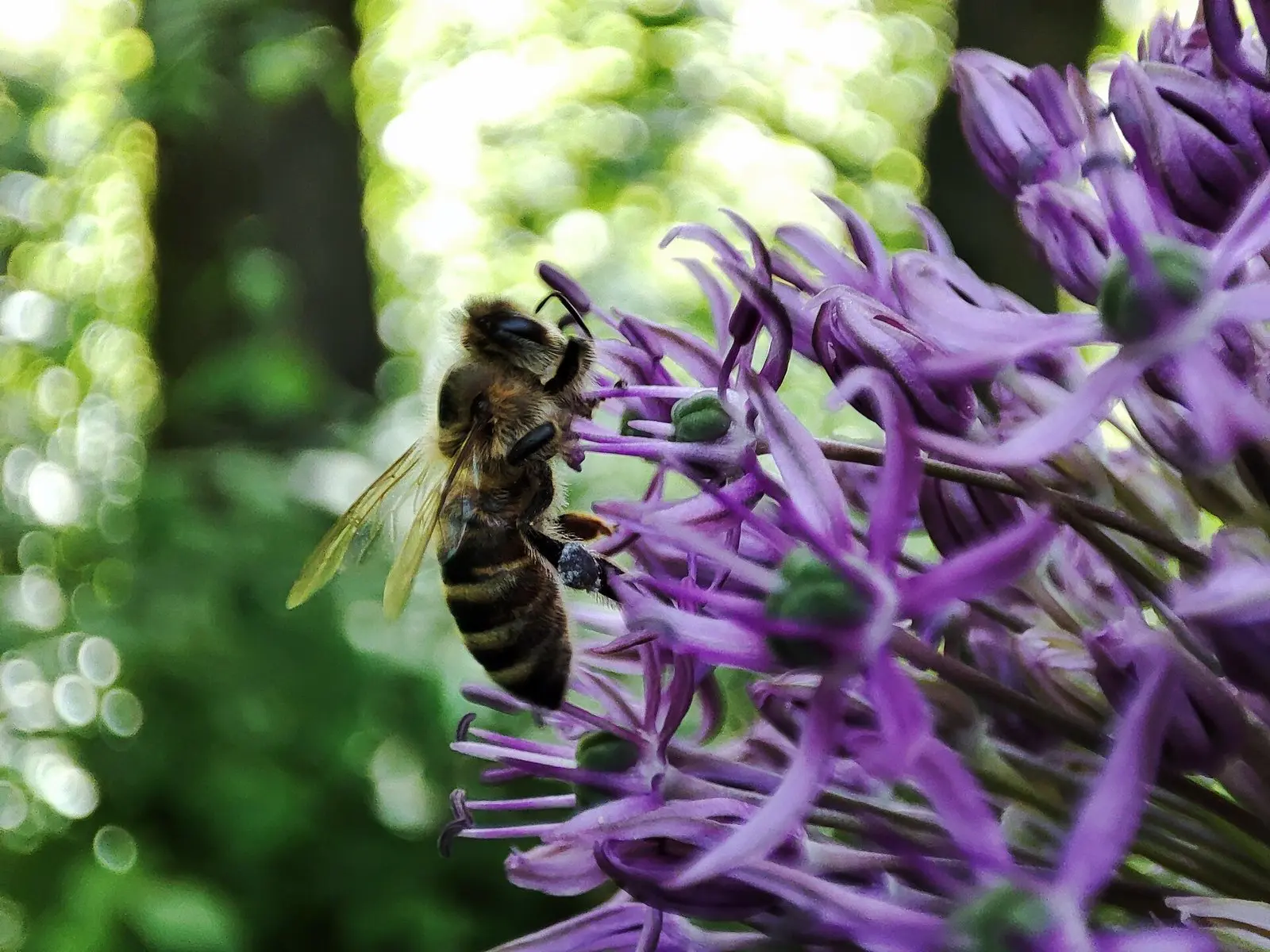
Photo by Humoyun Mehridinov on Wikimedia Commons, CC BY-SA 4.0

Updated Nov 2026
Which native bees live in your area depends on where you are in Australia. Stingless bees (Tetragonula) are common in Queensland and coastal NSW, blue-banded and teddy bear bees are seen in most states, and leafcutter, resin, reed and masked bees live in gardens across the country, including Victoria and Tasmania.
Use this guide to tell native bees from European honey bees and make your garden welcoming. Compare them in depth in our native bees vs introduced bees guide.
Bees are important because they produce honey – this is something that everyone knows and agrees upon. But there’s more to it. While it is true that we should always be grateful for being spoiled by honeybees with this sweet golden delight. We should focus on lending a helping hand to native bees. Honeybees get plenty of help from beekeepers and their issues are closely monitored. Unfortunately, the problems that native bees face tend to go unnoticed.
As mentioned above, native bees are great pollinators. They are, in fact, two to three times better at pollinating plants than honeybees. It is safe to say that they have great environmental importance. Unfortunately, they are in danger of becoming extinct. This is a big problem as the quality of our crops rely on both farmed and wild bees. We can go as far as to say that our food security depends on these friendly insects. But we have good news as well – there are many ways in which we can help our native bees.
Let’s dive into article to find out which native bees live in your area. We will also give you some tips on how to make your backyard more bee-friendly.
What Are Native Bees?
Native bees are bees that occur naturally in a certain region. In Australia, there are over 1,700 species of native bees, but only a few have been investigated. They come in many different shapes, sizes, and colours. Native bees can be metallic green, red, black, yellow, or patterned. Their bodies can be shiny and sleek or round and fuzzy. Most Australian native bees are solitary and are generally less aggressive than honeybees.
Photo by Paul VanDerWerf from Brunswick, Maine, USA on Wikimedia Commons, CC BY 2.0

Why Are Native Bees Important?
Native bees and the native flora and fauna have evolved simultaneously and, thus, depend on one another. As a result, Australian native bees are an essential part of the diverse and unique Australian ecosystems. In fact, many species depend on them.
Studies have found that native bees are more effective pollinators than European honey bees. In addition, they have a special ability called buzz pollination. This is a type of pollination that uses vibrations to collect and displace pollen. Buzz pollination is essential for the production of certain fruits including kiwi, tomato, blueberry, and eggplant.
So, to put it simply, native bees can pollinate native plants successfully and, in some cases, even introduced plant species. They are more effective, less aggressive, and less invasive than European honeybees. This makes them indispensable members of the Australian bush.
Examples of Australian Native Bees
There are hundreds or even thousands of native bees that benefit from the biodiversity of the Australian continent. Native bees thrive in all types of environments from tropical rainforests. From dry and hot deserts, and snowy mountains to more domestic settings such as gardens and backyards. There are many Australian native bees out there, and we are only familiar with a handful of them .If your garden is bee-friendly, maybe you’ll come across a less known type of bee. But first, let’s take a look at the most common ones.
The most common Australian native bees are reed bees, leafcutter bees, resin bees, Homalictus bees, and masked bees. Blue-banded bees and teddy bear bees are also very common but they are not endemic to Tasmania. Stingless bees and yellow and black carpenter bees are common in Queensland, New South Wales, Western Australia, and Northern Territory. And last but not least, green carpenter bees are common in Queensland, New South Wales, and South Australia.
Is It a Native Bee?
When the word bee comes up we always think of a fuzzy insect that has black and yellow stripes. However, the aforementioned native bees have vibrant colouring and can look similar to other insects such as flies or wasps.
If we want to be able to help our native bees we must tell them apart from European honeybees. Native bees can be black, dark brown, metallic blue or green, striped, or even spotted. It’s always a good idea to do some research and to check whether you’re looking at a native bee.
Another important characteristic of native bees is their solitary nature. Although we are used to thinking that bees live in hives, only a few of them do. Honeybees live in hives and form colonies and spend their lifecycles working and living as a group. They are known as social bees. For axample stingless bees belong to the social bees category. Australian native bees will only get together to mate and then resume return to their solitary life. The females lay eggs in nests built just for this purpose. Once their offsprings emerge, they separate from the mother bees and repeat the cycle. However, the vast majority of native bees lead solitary lifestyles.
Photo by U.S. Fish and Wildlife Service - Midwest Region on Wikimedia Commons, Public domain

What Can We Do to Help Native Bees?
The easiest way to help native bees is to create a friendly environment for them in your outdoor area. Australia has a wide variety of Native Bees. Therefore, your garden will become a home for these amazing insects. Especially once you make a few small changes and improvements.
If you already have a garden, check whether the majority of your plants are native or not. Native bees need native plants. Therefore, if your garden is filled with plants that aren’t native, it might be time to make some changes. Native plants tend to attract native pollinators. Native plants will also prove to be hardy and low-maintenance. This is because they are fully adapted to the growing conditions found in the area.
To make your garden more native bee-friendly, choose native plants that produce colourful flowers. Diversity is key because there are many different species of native bees endemic to each region. So, to keep all of them happy, transform your garden into a native wildflower paradise. Not convinced? Check out these beautiful wildflower bouquets.
Another important aspect that’s worth considering is ensuring you have plants with different blooming periods. Ideally, your garden will have flowers throughout Spring, Summer, and Fall. Some species of native bees are only active in spring. Some in summer, and others are active all year round. Therefore it’s important to have some blooms available for each of them.
Photo by Alvesgaspar on Wikimedia Commons, CC BY-SA 3.0

What Flowering Plants Do Native Bees Love?
Native bees love colourful, nectar-rich natives such as grevillea, bottlebrush, tea tree, eucalyptus and native daisies, plus herbs like lavender. See our full flowers for bees guide for an Australian planting list.
Photo by Humphrey Bolton on Wikimedia Commons, CC BY-SA 2.0

Extra Tips to Make Your Garden More Attractive for Native Pollinators
Don’t use mulch. Many native bees are solitary. In fact up to 70% of them will be grateful if they can dig holes in the ground. Using mulch in your garden will prevent them from building their nests and raising new generations.
Attract bees with real estate. Install some bee hotels or bee blocks in your garden. You can easily find many different options online and even easy DIY tutorials. You can also learn more about bee hotels from our guide.
Make flower borders. If you are growing fruits and veggies in your garden, you can encourage pollination by bordering them with native flowers. In doing so, you attract pollinators to the area. By doing this you offer them a source of food when your crops stop blooming. Flower borders will also attract other beneficial pollinators that deter certain crop pests.
Avoid using chemicals. You can’t have a bee-friendly garden if you use pesticides. We know that growing food can be challenging and that chemicals make it easier. However there are plenty of natural solutions that are just as effective and also eco-friendly. For instance, a lot of gardeners have found that ‘companion planting’ is extremely effective in avoiding a wide range of problems. Garlic can be grown alongside other veggies and it is a great aphid-repellant. Attracting natural pest-eaters is another great way to avoid pesticides.
Conclusion
Agriculture and our food systems would also be greatly affected by the disappearance of bees. There is some vegetation that humans would still be able to grow without bees. However fruits and vegetables would surely become luxury products.
Hand-pollination might be a solution. However it is a very expensive and labour-intensive one that most countries might not afford. Surviving without bees is possible in theory. Especially because humans are quite adaptable and can benefit from plenty of technological advances. However, chances are that many human lives would still be lost due to famine and poor nutrition. Therefore, it is in our best interest to protect our native bees. We should do everything we can to prevent their extinction in the future.