Photo by Tangopaso on Wikimedia Commons, (Public domain), cropped

In short: Western Australia has one of the world’s richest wildflower displays, with more than 12,000 plant species and a season that runs from about June to November. Highlights include everlastings, kangaroo paw, banksias, spider orchids and the wreath lechenaultia.
What comes to mind when you think of Australia? The Great Barrier Reef may get all the attention as one of the world’s great wonders, but what really stands out as an exceptional Australian treasure is something you can find above the waves and throughout the continent. We’re not talking about wide expanse of the Outback or the dramatic arcs of the Sydney Opera house – we’re talking about wildflowers of course!
Bet you didn’t know that Australia is home to over 24,000 species of weird and wonderful native plants! Well, it’s true. Western Australia alone has more than 12,000 species of native wildflowers, more than 60% of which can only be found here and nowhere else on earth.
From fields of wildflowers like the fantastical Everlastings, to what appears to be a floral wreath’s scattered along the red sandy trails, Australia is exploding with wildlife that will shock and awe you whether you’re a native or just passing through.
We’re going to concentrate on the wildflowers in and around WA, considering 12,000 of Australia’s wildflower species are native to this area. The best place to start is Kings Park. One of the world’s largest inner city parks, King’s Park is a 400-hectare botanical garden nestled in the heart of Perth, and it’s one of the best places to see WA’s wildflowers, with more than 3,000 species of WA plants. Plus you don’t even have to leave the comfort of the city! Since most of these native plants can be grown locally, and in doing so aid the local ecosystem and our native bees, we encourage you to give some of your favourites from this piece a try.
So if you’re ready for a tour down under and want to check out some of our amazing native flora, read on as we take you through a stack of native wildflowers, their flowering seasons, where you can find them, local tour information, and some excellent links to further your discovery.
When Is Wildflower Season in WA?
Western Australia’s wildflower season runs for about six months, from around June to November, and moves from north to south as the weather warms. It starts in the Pilbara in June, then spreads through the Goldfields and along the Coral Coast. Kalbarri National Park is usually at its best from about July to October, and Coalseam Conservation Park is known for its carpets of everlastings.
By September the flowers reach Perth. Kings Park and Botanic Garden, home to more than 3,000 species of WA plants, holds the Everlasting Kings Park Festival each spring, usually from mid-September into early October. The season finishes in the South West, around Margaret River and the south coast, in October and November. Rain makes a big difference from year to year, so check Tourism WA’s wildflower guide or Australia’s Coral Coast for what’s flowering before you go.
WA Wildflowers to See
Wreath Lechenaultia (Lechenaultia macrantha )

Photo by Calistemon on Wikimedia Commons, CC BY-SA 4.0, cropped

Does it look like someone has placed a floral wreath on the ground? We thought so too! But it’s just one of Australia’s unique native plants and it can be found growing wildly in sandy or gravelly soils in Western Australia. The Wreath Lechenaultia spreads to around 1 metre in diameter and about 150 millimetres in height.
The flowers predominantly occur around the outside of the plant between August and November, but this is significantly influenced by the onset of rain.
WA Shires where this plant grows in the wild include:
Dalwallinu
Greater Geraldton
Moora, Morawa, Murchison
Northampton
Perenjori
Shark Bay
Yalgoo
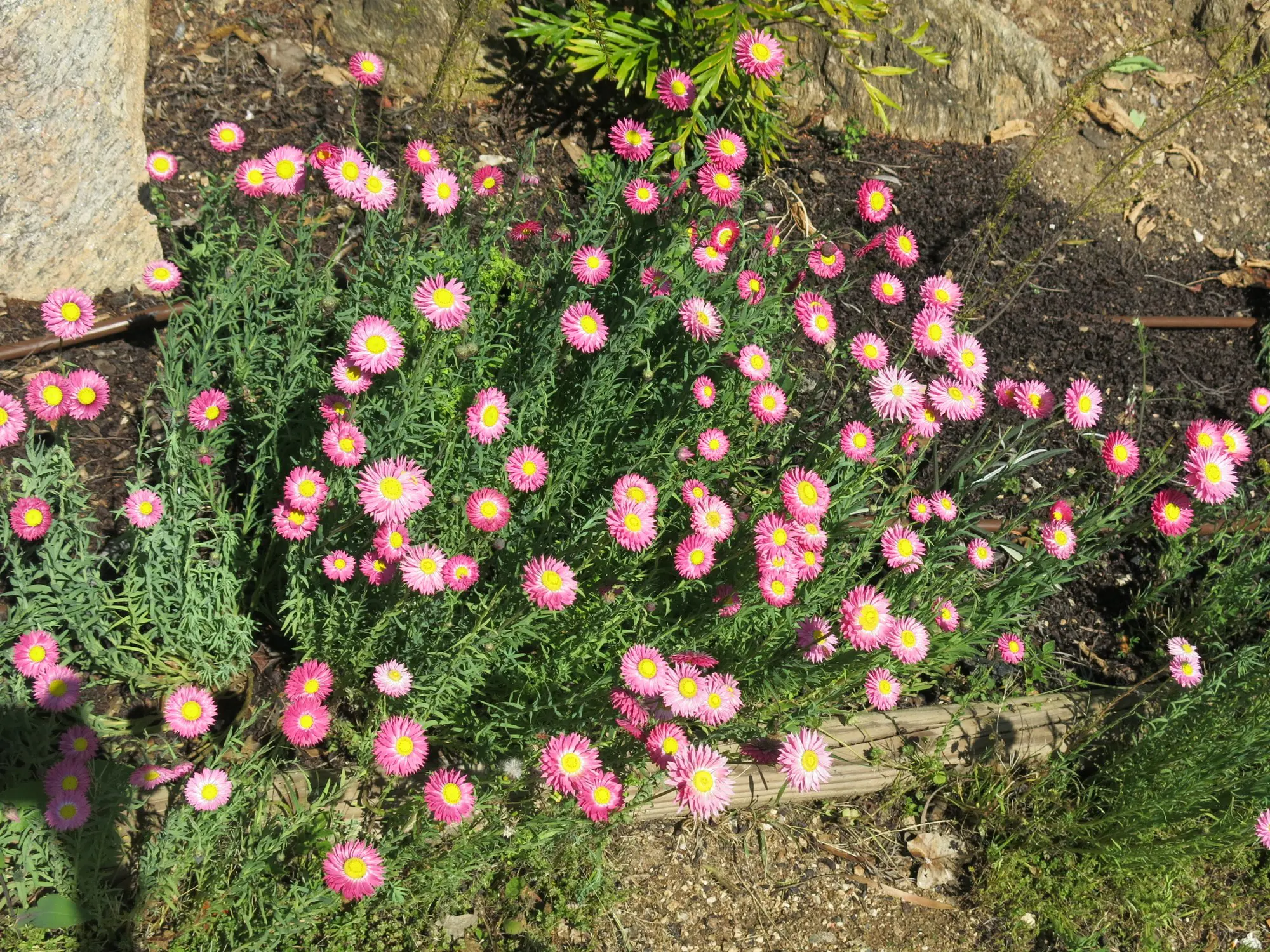
Everlasting Daisies

Photo by Dlanglois on Wikimedia Commons, CC BY-SA 3.0, cropped

Rhodanthe chlorocephala photo courtesy of Michelle(CC)
Everlastings are part of the Daisy family and they grow naturally southern areas of Western Australia and they also extend into South Australia. By themselves in your garden they look great but driving through Western Australia and seeing open fields or woodlands of everlastings in full bloom will make your day or even your year! Each stem supports a single flower which blooms to 60mm diameter. The flowers bloom for a good two weeks and are great for drying as they can last for years. The best types of Everlastings to grow in your garden are:
Rhodanthe chlorocephala subsp. rosea ‘Rosy Everlasting
Rhodanthe manglesii ‘Mangles Everlasting’ or ‘Silver Bells’
Everlastings are adaptable and can spring up throughout the year depending on the conditions. Flowering season in WA is usually August to November with the flowering season lasting up to 10 weeks.
Pink and White Everlasting (Rhodanthe chlorocephala)

Photo by Allthingsnative on Wikimedia Commons, CC BY 4.0, cropped

Showy Everlasting (Schoenia filifolia)

Photo by Geoff Derrin on Wikimedia Commons, CC BY-SA 4.0, cropped

Golden Everlasting (Xerochrysum bracteatum)

Photo by Casliber on Wikimedia Commons, CC BY-SA 3.0, cropped

Starflower (Calytrix brevifolia)

Pictured: Calytrix leschenaultii, a close relative of Calytrix brevifolia. Photo by Allthingsnative on Wikimedia Commons, CC BY-SA 3.0, cropped

So far there are about 75 species of native Calytrix in Australia with the majority being located around Geraldton, WA. The most common species is the Calytrix tetragona AKA Fringe Myrtle, can be found growing throughout Australia but the flower colour range is bland compared to the wildflower state, Western Australia, where its Calyrix species have a broad display of colours ranging from white, yellow, pink, purple and to red.
The Calytrix brevifolia is a shrub that grows between 500mm to 2.5m and the flowers appear between August and November. The star-shaped flowers bloom to around 20mm in diameter and the colour is dark pink to magenta with a yellow centre. The Flowers are 15 to 20 mm in diameter and once the petals drop after flowering the colourful sepals or calyces remain long after the flower has gone.
WA Shires where this plant may grow in the wild include:
Chapman Valley
Greater Geraldton
Irwin
Mingenew
Northampton
Shark Bay
Green bird flower (Crotalaria cunninghamii)

Photo by Atlas of Living Australia on Wikimedia Commons, CC BY 2.0

Another member of the Fabaceae (Pea) family, the Crotalaria cunninghamii is a perennial shrub between 1 and 3m high and its flowers are pollinated by birds and large bees. The flowers resemble birds touching the central stalk with their beak, giving the plant it’s common name “Green Birdflower”. The Green Birdflower can be found in the northern area’s of WA and around central Australia spreading into all mainland states, growing in the hot, arid areas and on unstable sand dunes.
WA Shires where this plant may grow in the wild include:
Broome
Carnarvon
Derby-West Kimberley
East Pilbara, Exmouth
Halls Creek
Karratha
Murchison
Port Hedland
Upper Gascoyne
Wiluna, Wyndham-East Kimberley
Mulla Mulla (Ptilotus exaltatus)

Photo by Diego Delso on Wikimedia Commons, CC BY-SA 3.0, cropped

With about 100 species of Ptilotus, all but one are endemic to Australia. Ptilotus exaltatus is an annual herb with pink to purple flower spikes and found throughout Australia preferring the hot, arid conditions. Mulla Mulla is also known as Pussy or lamb’s tails due to the appearance of the flowers which can be up to 150mm long and they bloom from July through to December.
A great place to see the Purple Mulla Mulla is the coastal plain of Exmouth Gulf where they thrive in amongst the beautiful wattles.
Good places to see this plant in the wild include:
Exmouth Gulf Plains
Yalgoo
Kennedy Range National Park
Anywhere hot and Arid
Hammer Orchids (Drakaea)

Photo by Kevin Thiele from Perth, Australia on Wikimedia Commons, CC BY 2.0, cropped

The Hammer Orchid is another one of our 40 weirdest flowers and is crazy looking orchid intent on being pollinated by a specific species of Thynid wasp. This orchid is remarkable, its flower resembles the female Thynid wasp (which by the way is flightless) and it also produces a scent that is very much like the female Thynid wasp’s pheromone!
There are ten species of Drakaea which are all found in Western Australia with 5 of the species being classified as “Threatened” by WA’s Department of Parks and Wildlife. Flowers are usually out between September and December but not every plant will flower.
WA Shires where this plant may grow in the wild include:
Albany, Augusta-Margaret River
Boyup Brook, Bridgetown-Greenbushes, Bunbury, Busselton
Canning, Carnamah, Collie, Coorow, Cranbrook
Dandaragan, Denmark
Esperance
Gingin
Harvey
Jerramungup
Kalamunda, Kent, Kojonup
Manjimup, Murray
Plantagenet
Serpentine-Jarrahdale
Wandering, Wanneroo, Waroona, West Arthur
York
Scarlet Feather Flower (Verticordia grandis)

Photo by Kevin Thiele from Perth, Australia on Wikimedia Commons, CC BY 2.0, cropped

This is a favourite genus of native flower in our cut flower industry with demand so high that research for farming these plants has been undertaken. There are now 99 recognised species with most of them in Western Australia. The Scarlet Feather flowers have a unique fringed calyx lobe giving the flower a feather-like appearance.
The shrub grows to 1-2 metres with flowers that are around 20-25mm in diameter that usually bloom from September through to January.
WA Shires where this plant may grow in the wild include:
Carnamah, Chapman Valley, Coorow
Dalwallinu, Dandaragan
Gingin, Greater Geraldton
Irwin
Mingenew, Moora
Three Springs
Shark Bay Daisy (Pembertonia latisquamea)

Photo by Kevin Thiele from Perth, Australia on Wikimedia Commons, CC BY 2.0, cropped

A member of the Daisy family, this climbing shrub that grows to around 1.5 metres high and loves deep sandy areas like sand dunes and plains. Flowers grow to around 50mm in diameter and it generally blooms from July to October.
WA Shires where this plant may grow in the wild include:
Carnarvon
Exmouth
Northampton
Shark Bay
Geraldton Wax (Chamelaucium uncinatum)

Photo by Forest & Kim Starr on Wikimedia Commons, CC BY 3.0

This is another favourite flower for our cut flower industry because they last for ages in an arrangement. There are 30 species of the Chamelaucium genus and all are endemic to Western Australia. The Geraldton Wax is relatively easy to grow and many varieties are available commercially. The shrubs typically grow to around 2 metres and flowering season for this plant is between June and November.
WA Shires where this plant may grow in the wild include:
Armadale
Carnamah, Chapman Valley, Chittering, Claremont, Coorow, Cottesloe
Dandaragan
Fremantle
Gingin, Gosnells, Greater Geraldton
Irwin
Jerramungup, Joondalup
Manjimup, Melville, Moora, Mosman Park
Narembeen, Nedlands, Northampton
Perth
Quairading
Serpentine-Jarrahdale, South Perth, Subiaco, Swan
Wanneroo, Waroona,
York
Firewood Banksia (Banksia menziesii)

Photo by Gnangarra on Wikimedia Commons, CC BY 2.5 au, cropped

From the Proteaceae family, we have the Banksia with around 170 species and all but one (Tropical Banksia) are native to Australia. Western Australia is the best place to see our diverse range of Banksia with over 150 of our Banksia species only occurring here. Banksia produce a significant amount of nectar critical for our nectar eating wildlife such as bats, native bees, birds and possums. Like other native Australian plants, the Banksia is adapted to bushfires, regenerating quickly after a fire passes through.
The common name “Firewood Banksia” is because of the fast burning properties but it is also known as Firewheel, Flame and Port Wine Banksia. Depending on the climate the Banksia menziesii becomes a gnarled looking tree that grows to around 10m or further north where it is hot and dry you will find the Banksia menziesii growing more like a one to three-metre shrub. Flowering season is between April and August with the flower spikes growing up to 80mm wide, 120mm long.
WA Shires where this plant may grow in the wild include:
Armadale
Bayswater, Belmont, Beverley
Cambridge, Carnamah, Chapman Valley, Cockburn, Coorow
Dandaragan
Fremantle
Gingin, Goomalling, Gosnells
Joondalup
Kalamunda
Mandurah, Melville, Murray
Nedlands, Northampton
Perth
Rockingham
Serpentine-Jarrahdale, South Perth, Swan
Three Springs
Wanneroo
York.
Spider Orchids (Caladenia spp.)

Photo by Geoff Derrin on Wikimedia Commons, CC BY-SA 4.0, cropped

Carousel Spider Orchid Photo courtesy of ron_n_beths pics (CC)
The Spider Orchid is a very nice find in the wild and the most spectacular ones can be found in (you guessed it) Southwest corner of WA. The Spider Orchids rely on being pollinated by pseudocopulation similar to the Hammer-orchid where they mimic specific insects or produce particular pollinators pheromones. Australia and WA, in particular, have hundreds of different species of spider orchids, natural and hybrids with more being discovered all the time.
Different species tend to be in different regions and we have listed a few below.
The Carousel Orchid (Caladenia arenicola)

Photo by Geoff Derrin on Wikimedia Commons, CC BY-SA 4.0, cropped

Cape Spider Orchid (Caladenia caesarea subsp. maritima Hopper & A.P.Br) is currently endangered.

Pictured: Caladenia woolcockiorum, a close relative of Caladenia caesarea. Photo by Tim Hammer on Wikimedia Commons, CC BY 4.0, cropped

Clubbed Spider Orchid (Caladenia longiclavata)

Photo by Geoff Derrin on Wikimedia Commons, CC BY-SA 4.0, cropped

The Blood Spider Orchid (Caladenia filifera)

Photo by Hugo Innes on Wikimedia Commons, CC BY 4.0, cropped

Karri Spider Orchid (Caladenia brownii)

Pictured: Caladenia multiplex, a close relative of Caladenia brownii. Photo by Hugo Innes on Wikimedia Commons, CC BY 4.0, cropped

Triggerplants (Stylidium spp.)

Photo by Hugo Innes on Wikimedia Commons, CC BY 4.0, cropped

Stylidium eriopodum Photo courtesy of ron_n_beths pics (CC)
Western Australia has over 150 species of triggerplants which are endemic to Australia. The Stylidium is diverse in shapes and sizes with some species growing to 1800mm high and others creeping across the ground. The flowers vary in shapes and sizes too, are symmetrical like a face and they have a sneaky way of being pollinated. From the throat of the flower protrudes a trigger which is activated when an insect lands on the flower. Once the flower detects pressure, the trigger harmlessly strikes the insect, covering it in pollen. The strike of the trigger is fast, 15 milliseconds, after a while it will reset and wait for the next visitor.
Stylidium fluminense

Pictured: Stylidium squamosotuberosum, a close relative of Stylidium fluminense. Photo by Jean from Perth, Australia on Wikimedia Commons, CC BY 2.0, cropped

Queen Triggerplant (Stylidium affine)

Photo by John Tann from Sydney, Australia on Wikimedia Commons, CC BY 2.0, cropped

Book Triggerplant (Stylidium calcaratum)

Pictured: Stylidium lobuliflorum, a close relative of Stylidium calcaratum. Photo by Hugo Innes on Wikimedia Commons, CC BY 4.0, cropped

Posy Triggerplant (Stylidium crossocephalum)

Photo by Lennix3 on Wikimedia Commons, CC BY-SA 4.0, cropped

Boomerang Triggerplant (Stylidium eriopodum)

Photo by Hugo Innes on Wikimedia Commons, CC BY 4.0, cropped

Pink Fountain Triggerplant (Stylidium brunonianum)

Photo by Kevin Thiele from Perth, Australia on Wikimedia Commons, CC BY 2.0, cropped

Australia’s State and Territory Floral Emblems
Every Australian state and territory has its own floral emblem, and the national emblem is the golden wattle. Here they are, with where to find them in the wild (see also Australian state flowers and what they mean).
Sturt’s Desert Pea (Swainsona formosa)

Photo by Calistemon on Wikimedia Commons, CC BY-SA 4.0, cropped

This unique flower made it into our 40 of the Worlds Weirdest Flowers and as the name suggests this plant is indeed a member of the Pea (Fabaceae) family.
South Australia adopted the Sturt’s Desert Pea as their floral emblem in 1961; it is also illegal to collect or pick the plant from Crown land unless you obtain a permit. The plant is generally treated as an annual, only lives for one year but grafted Sturt desert peas have been successful are expected to live three times as long.
Sturt’s Desert Pea is native to Australia; it grows naturally in most mainland states except for Victoria. The flowers are around 90mm long and is adapted to being pollinated by birds. Flowering occurs from July to March, but this is significantly influenced by the onset of rain.
Locations where this plant may be found in the wild include:
Flinders Ranges, SA
Glendambo, SA
Pilbara, WA
Kalgoorlie, WA
Frazer Range, WA
Karratha, WA
Finke, NT
Alice Springs, NT
Kings Canyon, NT
Sturt National Park, NSW
Royal Bluebell (Wahlenbergia gloriosa)

Photo by NathanHurst at English Wikipedia on Wikimedia Commons, CC BY-SA 3.0, cropped

The Royal Bluebell was chosen as the official floral emblem of the ACT in 1982. In the wild the Wahlenbergia gloriosa generally only grows above 1300 metres throughout the mountain ranges (Australian Alps) from the Australian Capital Territory, south-east mountains of New South Wales and across the border to the Eastern mountain forests of Victoria. There are twenty-one species of Wahlenbergia in Australia with nineteen of them growing throughout NSW. Wahlenbergia gloriosa is often mistaken for the Wahlenbergia gracilis (Australian Bluebell) because of the similar appearance and it’s more commonly found throughout NSW and VIC.
The Royal Bluebell is a frost tolerant ground-covering, perennial herb with 20 to 30mm diameter flowers appearing between October and March.
Locations where this plant may be found in the wild include:
Namadgi National Park, ACT
Mount Hotham, Vic
Kosciuszko National Park, NSW
Alpine National Park, Vic
Waratah (Telopea speciosissima)

Photo by Casliber on Wikimedia Commons, CC BY-SA 3.0, cropped

The Floral Emblem of New South Wales, the Waratah a shrub which grows between two and four metres with beautiful crimson flowers grouped into a rounded head with matching crimson bracts. The Waratah flowers produce vast amounts of nectar, very familiar with birds and the cute little Eastern Pygmy Possum. The Waratahs are cultivated in the Dandenong Ranges of Victoria and north of Sydney and they are also grown commercially in places like New Zealand, Hawaii and Israel for the cut flower industry due to their popularity in floral arrangements. There are five species of Telopea, all from south-eastern Australia: three are found only in NSW, one in Tasmania and one extends between Victoria and NSW.
Flowers are around 70 to 100mm in diameter and generally appear between August to November and possible spot flowering around March depending on conditions.
Locations where this plant may be found in the wild include:
Ku-ring-gai Chase National Park
Brisbane Water National Park
Dharug National Park
Macquarie Pass National Park
Pink Common Heath (Epacris impressa)

Photo by JJ Harrison (https://www.jjharrison.com.au/) on Wikimedia Commons, CC BY-SA 3.0, cropped

Slightly jealous of all the other states floral emblem names as ours sounds a little underwhelming “Common Heath” but don’t let the name put you off as this plant is far from common. These small, slender shrubs flowers were officially named the floral emblem of Victoria in 1958 There are around forty species of the Epacris, most of them are found in south-eastern Australia and just like our pavlova, the Kiwis have decided to claim a few species as New Zealand natives. There are many different coloured Common Heaths, ranging from Pure white, light pink, dark pink, crimson to scarlet.
Flowering season is around May to October with 25mm tubular flowers.
Locations where this plant may be found in the wild include:
Grampians National Park, Vic
Mount Lofty Ranges, SA
Around the Clyde River, NSW
Throughout Tasmania
Sturt’s Desert Rose (Gossypium sturtianum)

Photo by Mark Marathon on Wikimedia Commons, CC BY-SA 3.0, cropped

In 1961, the Northern Territory proclaimed the Desert Rose as its floral emblem however the original name was Cienfugosia gossypioides and that has since been replaced by the Gossypium sturtianum. In 1978 when the NT changed to self-government they incorporated the Desert rose into the design of NT flag. There are four species of the Gossypium genus that produce cotton, G. hirsutum, G. herbaceum, G. arboreum and G. barbadense. Unlike the fore mentioned cotton producing species, our Gossypium sturtianum seeds do contain hairs but they are useless as cotton fibre. The Gossypium sturtianum flower looks like a hibiscus flower which is one of the Desert Roses nearest Australian Cousins. A drought tolerant shrub which can grow to two metres the Sturt’s desert rose does not have a set flowering period but peak flowering is generally around August to September.
Regions where this plant grows in the wild include:
Burt Plain
Central Ranges
Davenport Murchison Ranges
Finke, Flinders Lofty Block
Great Sandy Desert
MacDonnell Ranges
Pilbara
Tanami
Cooktown Orchid (Dendrobium phalaenopsis or Vappodes phalaenopsis)

Photo by John Robert McPherson on Wikimedia Commons, CC BY-SA 4.0, cropped

The Cooktown Orchid was chosen as Queensland floral emblem in 1959, runner up was the Grevillea banksii. There is a little bit of debate and speculation over the correct species name because in 1959 the Cooktown Orchid was known as the Dendrobium bigibbum. However it is now also known as Dendrobium phalaenopsis or the latest name, Vappodes phalaenopsis. The Cooktown Orchid tends to form on rocks and trees with stems growing to 1200mm and the arching flower stems grow to around 400mm. The flowers vary from 30 to 70mm, which are larger than the original Dendrobium bigibbum. The orchid is considered threatened in the wild and is confined to the east side of Cape York Peninsula to as far north as the Iron Range.
Flowers appear from February to October with the peak flowering period being March to August.
Cooktown
Rinyirru National Park
Endeavour River Valley
Red and Green Kangaroo Paw (Anigozanthos manglesii)

Photo by Gnangarra on Wikimedia Commons, CC BY 2.5 au, cropped

The green and red Kangaroo Paw is also known as the Mangles Kangaroo Paw. This species of Kangaroo Paw can only be found naturally in Western Australia. On the 9th of November, 1960 Western Australia adopted the Red and Green Kangaroo Paw as its floral emblem and like the Sturt Desert Pea in South Australia, you need a licence to collect this plant from the wild.
Between August and November, you can see these magnificent Paws standing tall all around Perth.
WA Shires where this plant may grow in the wild include:
Armadale, Augusta-Margaret River
Boyup Brook, Busselton
Capel, Chittering, Cockburn, Coorow
Dandaragan
Gingin, Gosnells
Kalamunda, Kojonup
Manjimup, Melville, Mundaring, Murray
Northampton
Perth, Plantagenet
Serpentine-Jarrahdale, Shark Bay, Stirling, Subiaco, Swan,
Wanneroo, Waroona, West Arthur, Williams
York.
Tasmanian Blue Gum (Eucalyptus globulus)

Photo by Forest and Kim Starr on Wikimedia Commons, CC BY 3.0 us, cropped

Tasmania’s magnificent Blue Gum is a monster of a tree that can grow up to seventy metres with two metres of trunk diameter. It was in 1962 that the Tasmania Blue Gum was selected to be the State’s floral emblem. The flowers produce lots of nectar are an important source of food for our Native critters but also bees foraging on these flowers make a distinctive tasting honey. The Eucalyptus globulus is cultivated throughout Australia and places all around the world like Brazil, France, India and Spain. In California, it is so well established that many Californians assume that it is native to their area and is listed as an invasive plant by the California Invasive Plant Council.
Locations where this plant may be found in the wild include:
East Coast of Tasmania
Bruny, King, Flinders and Cape Barren Islands
Strzelecki Ranges-Wilsons Promontory, Vic
Otway Ranges
California, US
Golden Wattle (Acacia pycnantha)

Photo by Melburnian on Wikimedia Commons, CC BY-SA 3.0, cropped

The Golden Wattle is our national floral Emblem, green and gold! The Golden Wattle withstands our droughts and bushfires and its resilience represents The Australian people. The Golden Wattle is also a symbol of Unity and is now being embraced as a symbol of remembrance. 1901 the Golden Wattle was unofficially the National floral emblem but there was strong opposition to having the Waratah instead. On September the 1st, 1988 the Acacia pycnantha was finally proclaimed as the National Floral Emblem and four years later, the 1st of September was officially National Wattle Day. Read more about the Australian wattle tree.
Springtime sees the Golden Wattle blooming with its fluffy flower heads and up to eighty tiny sweet smelling flowers proudly displaying the national colours.
locations where this plant may be found in the wild include:
Eyre Peninsula, SA
Flinders Ranges, SA
Western Victoria
Southern inland NSW
Around Canberra of course.
Bring Australian Wildflowers Home
Are you feeling inspired yet? Good!
Most of the native plants featured in this piece can be grown in our very own gardens and yards! So if you’ve got a green thumb or are just curious, give it a go and plant some native wildflowers.
Remember that by growing native plants we are helping our native wildlife, especially our native bees! Give nature a hand and plant some native flowers. For more, see our grand collection of Australian native flowers.
Please don’t pick wildflowers in the wild. WA’s native plants are protected, and taking them from Crown land such as roadsides, state forests and national parks needs a flora licence from DBCA.
If you’d rather bring the colour indoors, browse our native flowers, with same-day delivery when you order before the daily cut-off.
Further Reading and References
Tourism Western Australia: find wildflowers for where and when to go
Australia’s Coral Coast: wildflowers for self-drive tours, maps and what’s flowering
Australian Native Plants Society
Department of Climate Change, Energy, the Environment and Water