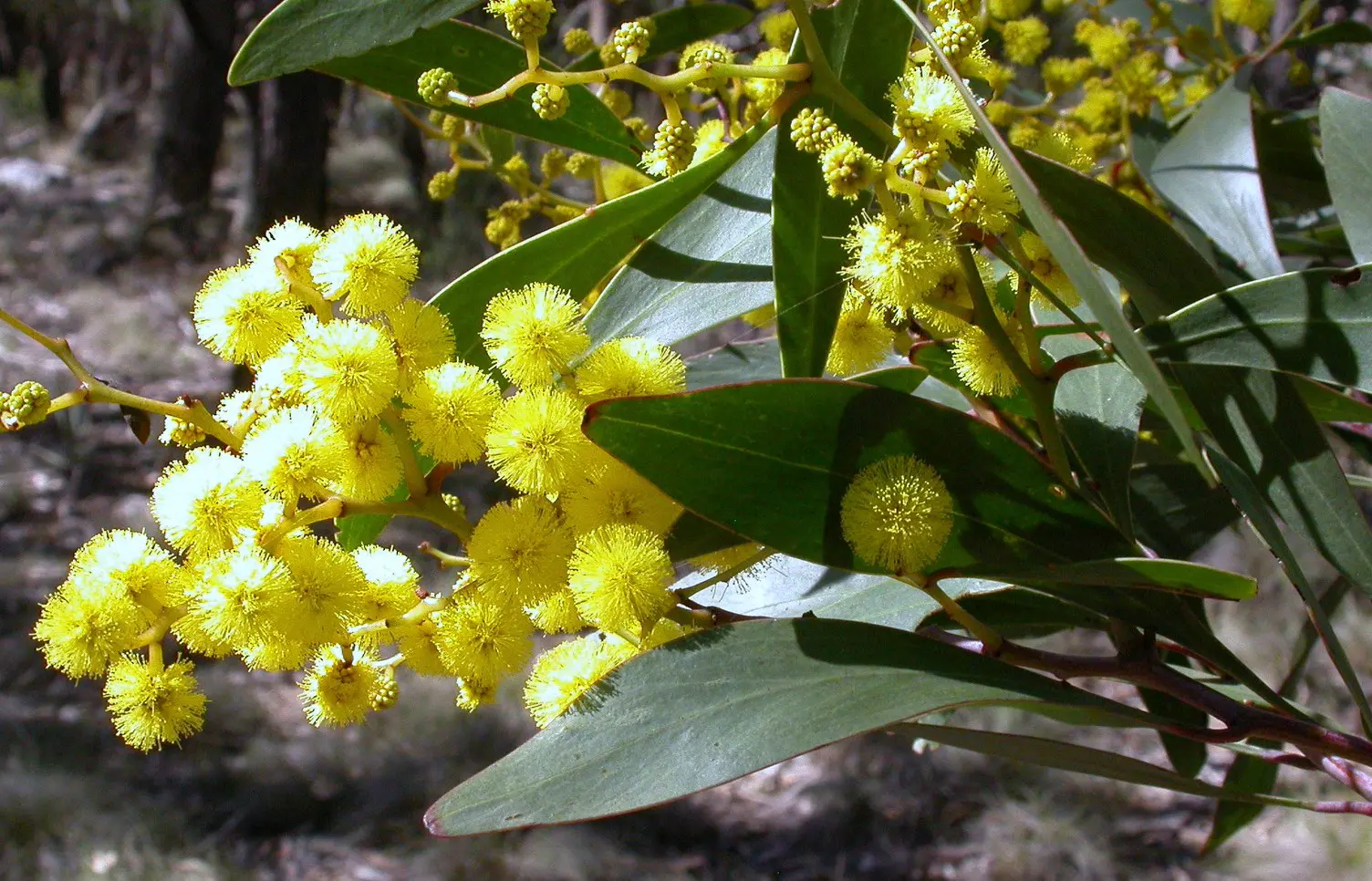
Photo by DavidFrancis34 from Australia on Wikimedia Commons, CC BY-SA 2.0, cropped

Australia is a beautiful country with plenty of unique flora and fauna. But did you know that each Australian state and territory has its own official flower? This post looks at Australia’s state and territory flowers, and the history and meaning behind each. From the tiny Sturt’s Desert Pea of South Australia to the vibrant Waratah of New South Wales, there’s something for everyone.
Grab a cuppa and get ready to learn all about our nation’s stunning native florals!
In short: every Australian state and both mainland territories have an official floral emblem, and golden wattle is the national one. Here they are at a glance (dates from the Australian National Botanic Gardens):
| State or territory | Floral emblem | Scientific name | Proclaimed |
|---|---|---|---|
| Victoria | Common heath (pink form) | Epacris impressa | 11 November 1958 |
| Queensland | Cooktown orchid | Dendrobium phalaenopsis | 19 November 1959 |
| Western Australia | Red and green kangaroo paw | Anigozanthos manglesii | 9 November 1960 |
| Northern Territory | Sturt’s desert rose | Gossypium sturtianum | 12 July 1961 |
| South Australia | Sturt’s desert pea | Swainsona formosa | 23 November 1961 |
| New South Wales | Waratah | Telopea speciosissima | 24 October 1962 |
| Tasmania | Tasmanian blue gum | Eucalyptus globulus | 27 November 1962 |
| Australian Capital Territory | Royal bluebell | Wahlenbergia gloriosa | 26 May 1982 |
| Australia (national) | Golden wattle | Acacia pycnantha | 1988 |

Photo by John Tann from Sydney, Australia on Wikimedia Commons, CC BY 2.0

Australian State Flowers: Common Heath – Victoria
Epacris impressa
With stunning petals that fuse into a tube, the Common Heath is anything but common. The Floral emblem of Victoria belongs to the Ericaceae family, found across NSW, Victoria, Tasmania and South Australia. In fact, it grows in shrubland and open forests.
Standing at about 1 to 1.5m tall, the Common Heath produces a shrub with stiff branches, from which its leaves and flowers bloom. Its five-petal flowers grow either packed together or sparsely on one side of a stem and flower from late autumn to late spring, with a peak in winter. In fact, curiously, Epacris impressa regenerates after bushfires by seed or by resprouting.
It was first discovered in Van Diemen’s Land (Tasmania) by French botanist Jacques Labillardière in 1793. The species was not documented until 1805. Four forms exist, you can identify these forms by the petals.
White Heaths are in Southern Victoria. Meanwhile the more Pink Heath variety grows in Victoria and Tasmania. The grandiflora is another Pink Heath from the Grampians and Mount Arapiles in Victoria. Scarlet heaths grow in East Gippsland in Victoria. The original mounted specimen is at the National Herbarium of Victoria at the Royal Botanic Gardens, Melbourne.
Victoria was the first state to adopt a floral emblem, following an agreement in 1951 between government representatives and other local stakeholders, with Governor Dallas Brooks making the Victoria floral emblem proclamation on 11 November 1958. 
Photo by Hughman on Wikimedia Commons, CC BY-SA 3.0, cropped

Australian State Flowers: Waratah Flower – New South Wales
Telopea speciosissima
The Waratah Flower flowers for six weeks during the spring. It’s native to the sandstone country of the NSW coast and ranges, from about Ulladulla north to the Watagans and west into the Blue Mountains. Its flower head is made up of between 90 and 240 individual flowers. While Waratah flowers are typically red or pink, naturally occurring colours can vary considerably, as does the size and shape of the blooms.
Growing upwards of 3m tall, the large and long-lived shrub Telopea speciosissima gets its name from the Greek word telopos, meaning ‘seen from afar’, clearly referring to the conspicuous basal flowers. A feature also reflected by speciosissima, a combination of the Latin words speciosus, ‘showy’ and issimus, ‘most’.
Described as “the most magnificent plant which the prolific soil of New Holland affords’’ by botanist Sir James Smith in 1793, Waratahs were proclaimed the floral emblem of New South Wales on 24 October 1962.
Photo by John Robert McPherson on Wikimedia Commons, CC BY-SA 4.0

Australian State Flowers: Cooktown Orchid – Queensland
Dendrobium phalaenopsis
When Queensland considered adopting a state flower, the state had strict criteria. In fact, the flower had to be a native species. The flower had to be decorative and distinctive in appearance. But most importantly, its colour had to match that of the state, maroon.
After much deliberation and a public poll of 10,917 entries conducted by The Courier-Mail the results were in. The Cooktown orchid became the floral emblem of Queensland on 19 November 1959, just one year after Victoria adopted the common heath. In fact, according to the Courier, “Queensland’s own world-famous hybrid [sic] orchid came out thousands ahead in the count of votes”, beating out Poinsettia, the floral emblem of the capital city, Brisbane.
The Cooktown orchid grows on trees and rocks in far north Queensland, mainly on Cape York Peninsula. It was proclaimed under the name Dendrobium bigibbum var. phalaenopsis, and botanists now call it Dendrobium phalaenopsis. Like other native orchids, it is protected in the wild, so buy nursery-grown plants.
Photo by SeanMack on Wikimedia Commons, CC BY 3.0

Australian State Flowers: Kangaroo Paw – Western Australia
Anigozanthos manglesii
Resembling the paws of a kangaroo, the Red and Green Kangaroo Paw is the state flower of Western Australia. It is named after Robert Mangles, a 19th-century English horticulturalist.
Kangaroo paws are found only in the south-west of Western Australia. The genus is a small group of about 12 species growing in open forests and heaths (shrubland), typically in sandy soil. Often occurring in large numbers, the red and green kangaroo paw is an attractive flower that blooms from August to November, peaking in early spring. Although the species is no longer at threat, it is still protected under WA state legislation.
Raised at Whitmore Lodge in the 1830s, the seat of its namesake Robert Mangles, it was here that Scottish botanist David Don first described Anigozanthos manglesii as a “singularly beautiful species”. More than a century later, on 9 November 1960, the government of Premier David Brand adopted the Red and Green Kangaroo Paw as the state’s floral emblem. Also appearing on the state’s coat of arms, the blazon reads:
“And for Crest: On a Wreath Or and Sable The Royal Crown between two Kangaroo Paw (Anigosanthos [sic] Manglesii) flowers slipped proper.”
Photo by NathanHurst at English Wikipedia on Wikimedia Commons, CC BY-SA 3.0, cropped

Australian State Flowers: Royal Bluebell – Australian Capital Territory
Wahlenbergia gloriosa
Adopted as the floral emblem on the 26th of May, 1982. The Royal Bluebell is a perennial herb that produces a single purple flower with a tube-shaped base.
Naturally restricted to alpine and sub-alpine areas of the Australian Capital Territory. The Royal Bluebell also grows in south-eastern New South Wales and eastern Victoria. Additionally, it flowers from October through to March. In fact, the flowers do not last if cut. Fortunately, potted Royal Bluebell flourishes in brightly lit areas.
Formally described in 1947 by Noel Lothian. Named after gloriosa. A Latin word meaning ‘famous’ or ‘splendid’.
Photo by Forest and Kim Starr on Wikimedia Commons, CC BY 3.0 us, cropped

Australian State Flowers: Tasmanian Blue Gum – Tasmania
Eucalyptus globulus
Known as the southern blue gum, this tall, evergreen tree is endemic to southeastern Australia. Making it one of the most iconic trees in Australia.
Notable for its glossy green leaves and tree trunks of mostly smooth bark. There are four subspecies of E. globulus: Tasmanian blue gum (the emblem), Victorian or southern blue gum, Maiden’s gum and the Victorian eurabbie. Between them they are found across New South Wales, Victoria and Tasmania.
The Tasmanian Blue Gum was proclaimed as the floral emblem of Tasmania on 27 November 1962. That was more than 160 years after it was formally described in 1799. Specimens of Eucalyptus globulus were first collected in Tasmania in 1792–93 by the French botanist Jacques Labillardière, who later published it in his book Relation du Voyage à la Recherche de la Pérouse.
Eucalyptus globulus can grow to an average height of 45m, though some specimens grow much taller. These large Tasmanian Blue Gums will form a lignotuber, a woody swelling at the base of the tree as a protection against the destruction of the plant stem, such as by fire.
That being said, fire ecologist Stephen Pyne in his book Burning Bush. He describes fire as a “liberator” rather than a destroyer for most eucalypts. Despite having bark that peels from the trunks, spilling out into piles around the tree. This thick bark allows many species of eucalyptus to tolerate fire, with epicormic shoots often found in the aftermath of bushfires. Bushfires can even create new sprouts from the lignotuber.
Eucalyptus is derived from the Greek words eu, ‘well’ and calyptos, ‘covered’, referring to the cap covering the developing flowers. The Latin term globulus refers to the shape of the operculum (the lid on the fruit).
Photo by Jim Bendon from Karratha, Australia on Wikimedia Commons, CC BY-SA 2.0, cropped

Australian State Flowers: Sturt’s Desert Pea – South Australia
Swainsona formosa
Producing a distinctive blood-red and leaf-like flower with a bulbous black centre. “Boss”, Swainsona formosa or Sturt’s Desert Pea, as it is more commonly known, is one of Australia’s most well known and beloved wildflowers. Growing in all mainland states except Victoria, Sturt’s Desert Pea prefers arid regions of Australia.
Although it is a member of Fabaceae, subfamily Faboideae. It barely resembles any other member of the pea family, thanks to the wildly different flowers it produces. They grow to about 9cm in length in six clusters along the plant’s thick vertical stalks.
Samples of Swainsona formosa were first collected by William Dampier in 1699. Which are still on display today in the Fielding-Druce Herbarium at the University of Oxford in England. Though Sturt’s Desert Pea shares its name with English botanist Isaac Swainson, its taxonomy has changed numerous times. For many years it was placed in the genus Clianthus as Clianthus dampieri, as Clianthus formosus. With formosus being the Latin word for ‘beautiful’.
And despite a further reclassification attempt to Willdampia formosa (in honour of the explorer William Dampier) in the publication Western Australian Naturalist in 1999, Joy Thompson was the last to reclassify the flower under the genus Swainsona.
Sturt’s Desert Pea has been the floral emblem of South Australia since 23 November 1961, when it was adopted under the name Clianthus formosus. It has enjoyed iconic status across the country, even being used as the previous logo of BankSA. It’s even been featured in aboriginal legends, giving credence to its symbolic function in Australia.
Photo by Mark Marathon on Wikimedia Commons, CC BY-SA 4.0, cropped

Australian State Flowers: Sturt’s Desert Rose – Northern Territory
Gossypium sturtianum
Despite the name, Sturt’s Desert Rose isn’t a rose. It’s a hibiscus-like flower that grows throughout the arid interior of Australia.
Adopted as the floral emblem of the Northern Territory on 12 July 1961. The proclamation was made using its former name Cienfugosia gossypioides. As a result, the Majority Leader in the Legislative Assembly of the Northern Territory re-confirmed this species as the floral emblem. This was done in an Executive Statement in June 1975.
Also known as the Darling River Rose. In fact, Its less widely-used names – Cotton Rosebush and Australian Cotton. The names are inspired by Sturt’s Desert Rose genus, Gossypium. Which includes commercial cotton. Unfortunately, the short hairs covering its seeds are much shorter than its commercial cousin, making it useless for textiles.
Charles Sturt and His Sturt Flowers
The keen-eyed amongst you may have noticed that the common name Sturt popped up twice on our list. First as a Desert Pea and secondly as a Desert Rose. Eponymous for the university in regional NSW named in his honour. Charles Sturt was a European explorer who recorded seeing large quantities of the flower while exploring central Australia in 1844.
Though he believed his explorations would lead him to discover a great saltwater lake. Known as ‘the inland sea’, in the middle of Australia, extreme conditions forced him and his party to turn back after travelling a total of about 4,800 km.
In February 2011, Charles Sturt University changed its logo, stylising the bright red petals of Sturt’s desert pea flower.

Photo by Melburnian on Wikimedia Commons, CC BY-SA 3.0, cropped

Australian Floral Emblem: the Golden Wattle
Acacia pycnantha
One flower to rule them all. Well, not quite. Close to 1,000 different types of wattle call Australia home, including the national flower of Australia, the Golden Wattle. Golden wattle grows naturally in South Australia, Victoria, New South Wales and the Australian Capital Territory. This evergreen spreading shrub or small tree likes open forest, woodland and scrub.
Bursting with national colours of green and gold, the Golden Wattle has been an Australian symbol since Federation. Much like the unofficial tradition of wearing a wattle blossom on the 1st of September. It was widely treated as the national flower long before it became official.
According to the Department of Prime Minister and Cabinet, it was not until 1988 (Australia’s bicentenary year) that Governor-General, the Rt Hon Sir Ninian M Stephen AK GCMG GCVO KBE, proclaimed the golden wattle as the national floral emblem. He signed the proclamation on 19 August 1988, and it was gazetted on 1 September 1988.
In 1992, 1 September was formally declared National Wattle Day. Wattle Day celebrations go back to the early 1900s, and today Aussies celebrate by wearing a sprig of wattle or planting one.
The specific epithet pycnantha is derived from the Greek words pyknos ‘dense’ and anthos ‘flower’. The origin of the name wattle. On the other hand, is derived from an Anglo-Saxon, or Old English, building technique known as watul. Where Wattles were interwoven with flexible twigs or small branches to support fences, walls and roofs.
Native Flowers Delivered to Your Door
Flowers Across delivers market-fresh flowers across Australia, with same-day delivery when you order before the daily cut-off. Browse our native flowers, or send an Awesomely Aussie native posy, handcrafted to order by our florists.
Want more on our native flora? Read about the Australian wattle, explore Australian native flowers: the grand collection and Queensland’s unique native flowers, or see the national flowers of 10 countries.